Niki Russ Federman & Josh Russ Tupper
Co-Owners, Russ & Daughters
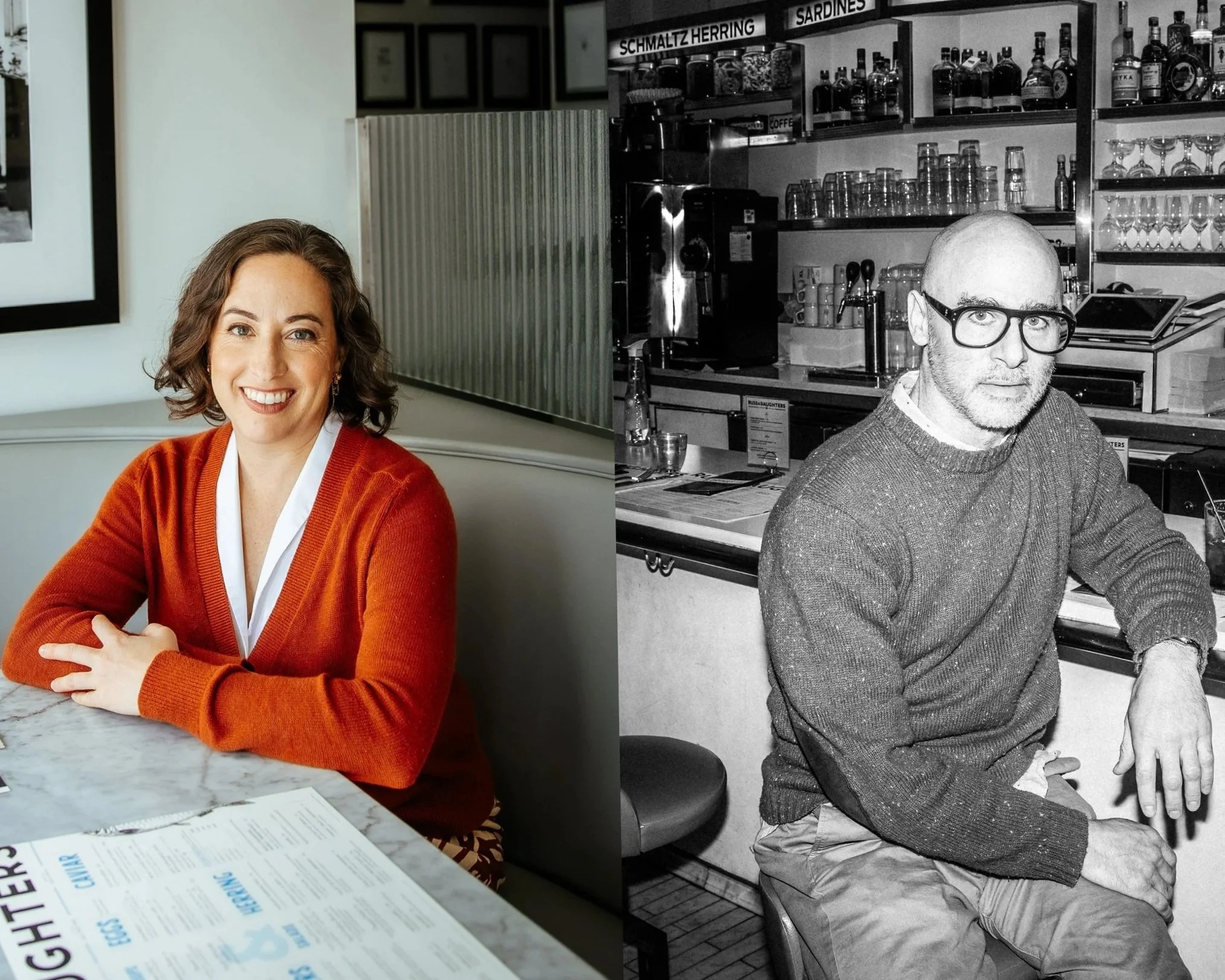
We want to exist at the meeting point between tradition and innovation—where continuity gives meaning to everything we do.
Summary
In this episode of “Leadership Matters,” Alan Fleischmann sits down with Niki Russ Federman and Josh Russ Tupper, fourth-generation owners of Russ & Daughters, the iconic New York appetizing institution founded in 1914.
They share their deeply personal journeys back to the family business, reflecting on the mentors, experiences, and pivotal moments that shaped their leadership philosophies. From Niki’s inspiration drawn from Howard Schultz’s concept of the “third place” to Josh’s diverse leadership influences, the conversation highlights how different paths can converge into a shared vision.
Together, they explore how to balance tradition with innovation, preserving a cultural legacy while evolving to meet modern demands. They discuss expanding into new formats like restaurants and e-commerce, navigating risk, and maintaining an unwavering commitment to quality and human connection.
Mentions & Resources
Russ & Daughters: 100 Years of Appetizing, by Niki Russ Federman & Josh Russ Tupper
Pour Your Heart Into It, by Howard Schultz
Guest Bio
Niki Russ Federman
Niki Russ Federman is the fourth-generation co-owner of Russ & Daughters. At the age of 27, Russ Federman chose to return to the shop in which she grew up. Together with her cousin, Josh, she has grown Russ & Daughters into what it is today, while preserving its cultural and culinary legacy. Russ Federman has been featured in The Sturgeon Queens, the award-winning documentary about Russ & Daughters; television shows such as Taste the Nation with Padma Lakshmi and Anthony Bourdain’s No Reservations; and publications including The New York Times, The New Yorker, Food & Wine, Zagat, Vogue, and W Magazine. She was inducted into the Manhattan Jewish Hall of Fame and has an encyclopedic entry in the Jewish Women’s Archive. She lives in Brooklyn with her husband, Christopher, and two children.
Josh Russ Tupper
Josh Russ Tupper is the fourth-generation co-owner of Russ & Daughters. Raised in an ashram in upstate New York, Russ Tupper was working as an engineer in Portland, OR, when the opportunity arose to join his family business at 26. He has been leading Russ & Daughters with his cousin Niki ever since. He has been featured in media outlets such as NPR, Food Network, The Travel Channel, Forbes, The Cut, Kinfolk, Lucky Peach, The New Yorker, and Vogue. He is also one of the subjects of documentary The Sturgeon Queens. Called “the Babka Baron” by the New York Times, Josh has been honored by the Museum of Food and Drink for his contributions to NYC food culture. He has taught at the YIVO Center for Jewish Research and Astor Center. Russ Tupper lives with his wife, Denise, and two daughters.
Episode Transcript
Alan Fleischmann
Welcome to “Leadership Matters” on SiriusXM and at leadershipmattersshow.com. I'm your host, Alan Fleischmann. I'm joined today by two remarkable leaders who are the owners and stewards of one of New York City's most iconic culinary institutions.
Niki Russ Federman and Josh Russ Tupper are the fourth-generation co-owners of Russ & Daughters, an appetizing store — and, frankly just one of the best restaurants and food shops — that serves smoked fish, bagels, bialys, and a variety of other traditional baked goods at locations across New York City.
Founded in 1914 by their great-grandfather, Joel Russ, Russ & Daughters has been family-run ever since, attracting a loyal customer base that has included everyone from Lou Reed to Ruth Bader Ginsburg. It continues the unique Jewish tradition of appetizing while continuing to innovate. Its four locations across New York are consistently recognized as among New York's finest places to eat.
Initially bound for very different career paths, cousins Niki and Josh both chose to return to Russ & Daughters as co-owners in their mid-20s and have been instrumental in its continued success ever since. Last fall, the two published Russ & Daughters: 100 Years of Appetizing, a national bestseller that tells the story of the family and the shop through its history, memory, and more than 100 cherished recipes. Niki and Josh have a remarkable story to tell about cultural stewardship and the challenge of running a family business. Today, we'll explore their unique journeys, the history of Russ & Daughters, their vision for its future, and the lessons in leadership they've learned along the way.
Niki and Josh, welcome to “Leadership Matters.” It's a pleasure to have you on.
Niki Russ Federman
That was fantastic, Alan. And you didn't call us a deli.
Alan Fleischmann
You know what? I could never call you a deli, because when I think of deli, I don't think of curated foods and the best quality. I think of you guys if you want to walk in and have the very finest, most delicious, and in many cases, the most sophisticated foods. You go to Russ & Daughters. A deli is fun in the neighborhood. Grab a bagel, I guess. But this is much more. This is if you want both.
Josh Russ Tupper
Yeah, that's right.
Alan Fleischmann
So it's a family business, and it must be very personal, because it's both your profession and your family history. Tell us a little bit about that family history when you grew up. I’m curious whether you both had aprons around your waists as little kids.
As Niki knows well, I sold cheese from 15 years old until I was in my mid-20s at very elegant cheese shops and gourmet shops. I learned so much that if I wrote a book, it would be I Learned Everything I Know from Selling Cheese.
I'm curious what your earliest memories are, your earliest life memories. What was life around the house? How important was Russ & Daughters in your youth? And how often were you at Russ & Daughters as children, actually?
Niki Russ Federman
I'll start off — Alan, you and I bonded when we first met over both being shop kids and both recognizing the sort of foundational education that we got being in and around shops. For me, that was very much the case, because growing up, Russ & Daughters was a literal Mom and Pop for me, because it was my mother and father who ran our store for 30 years. So I spent a lot of my childhood, at first just hanging around, and then over time, little by little, being brought in to do different tasks — answer this phone call, go hand out this order, go pick up a roll of quarters from the neighbor shop.
One of my earliest memories — I think I was like five or so — I gave myself a job, which was I would stand at the door. And if you know the original Russ & Daughters store on the Lower East Side, there is only one door, so everything and everyone is coming in and out of there. I would wait for the produce delivery guys to come, and they would wheel in 50-pound sacks of onions, potatoes, carrots, whatever we had ordered, and they would push the sacks on these hand trucks. I would climb on top of their sacks, like a chariot, I would direct them to the back of the store, where the kitchen and the storage is.
I felt very important. I was convinced that without my direction, they were sure to get lost, even though there's nowhere to go. It's a straight shot through the store to the back.
All that is to say that, from a very young age, I was sort of picking up — through osmosis, the interaction with the breadth of humanity that inhabited this space, the conversations that happen across the counter — the dance, the rhythm of a shop, how you move through it, and the realness of the food; the making, packaging, slicing, and selling our food. It really became so much a part of who I was and am, but I didn't even know it at the time. I thought for a very long time that if you walk into a small shop, of course you hug and you kiss the shopkeeper, because that's what happened at Russ & Daughters growing up.
So I watched my parents work. I think I was fortunate to understand in a very real way how my parents made their living, and I saw how this — our food and our store — was such a touchstone for people in their lives, whether it's just how they operated their daily New York life to grab a bagel and a coffee, or whether this was the food that they needed to have to mark an important life event: a baby being born, someone passing away, and everything in between. So yeah, it was very formative for me.
Alan Fleischmann
And you have siblings also?
Niki Russ Federman
I have an older brother, but very different. From a very young age, he knew that this was not his path, and he became a doctor and put himself on that track early on. I remember we both were expected to work during busy holiday times. There was one holiday when he knew he was going off to do his residency in California — he was already in medical school, but he was going off to do his residency — and he was handing out orders to customers. We know so many of our customers, and he would tell each person, "This is the last time you see me here. I won't be here next holiday."
Josh Russ Tupper
The black sheep of the Russ family is a doctor. A very good doctor.
Alan Fleischmann
I love that.
And then, Josh, you did not grow up going to the store?
Josh Russ Tupper
No. Very, very different story and very different reason. I thought you should hug and kiss basically everyone around you. I grew up on an ashram upstate. My mother was more of a black sheep of that generation. She went and did the hippie thing in the ’60s and raised me and my two sisters on an ashram just an hour north of the city.
So there wasn't a lot of connection to Russ & Daughters. It was a very different picture of my reality and visiting Russ & Daughters than Niki's. We would go down there in the early ’80s, mid-’80s, coming from an 80-acre ashram running around with or without clothes on, no worry in the world, to the Lower East Side in the '80s, where there were people sleeping on the street and if you locked your car, it would basically get broken into, and if you didn't lock it, they would just take everything inside of it. I remember one holiday, we drove down with a bunch of gifts in the car and came back and windows were broken and all the gifts were gone.
But we did go to the store, and my earliest memories of that was basically being greeted by all the staff there that had been there for ages, and attempting — or thinking I was — stealing candies and licorice by going to the other side and filling my pockets with these hard candies. It was sanctioned, I'm sure. But then going and eating a big spread of Russ & Daughters, either at Niki's house or at my grandmother's house in Gramercy.
Alan Fleischmann
That means your mothers were the sisters, the daughters?
Niki Russ Federman
No, it was our grandmother.
Josh Russ Tupper
And her sisters.
Alan Fleischmann
hat's amazing, actually. So explain something to me, both of you… The journey of getting you back here, we're going to get to in a minute, because there's a journey that neither one of you probably, in a million years, thought you were doing, and then you guys sequentially came to it. But explain a little bit what it means to be an appetizing store. I mean, I purposely did not say the word “deli,” because I know it's not a deli. But with the term "appetizing store," it's something I think about with Russ & Daughters, honestly, and I get it. But you do more than appetizing. You have a restaurant. So I feel like I don't want to fool people that if you think you're going to come over and just have a little this and a little that — yes, you could do that. But if you want to feast, you can have a feast at Russ & Daughters too.
But is the appetizing story your elegant way of differentiating the quality of what this is versus a deli? Is that why? Or is it really meant that it's, you know, we really do curate and we do focus on appetizers?
Josh Russ Tupper
Well, this term "appetizing" is actually a New York-born tradition, and it is a thing. It's much less widely known than the deli, but the differentiation between deli and appetizing was from kosher law. Deli was meat, and you can't eat meat with dairy if you're kosher. So appetizing stores are smoked and cured fish, and then dairy. So cream cheese, bagels. It's not appetizers, even though our sign says "appetizers." It is food you don't have to cook, so I think that's part of it. But it is appetizing as a noun.
Appetizing stores in the early 20th century were all over the place. There were probably 30 appetizing stores on the Lower East Side alone. And this tradition, while there are a few left, has really not developed like the tradition of deli. As you said, deli is now like any corner store. You can get anything. But the foundation of that word is the meat, and the appetizing is the fish and the dairy.
Niki Russ Federman
To make it a little even more confusing, you're not wrong to call it appetizer, or to notice that our neon sign does say "appetizers," because the term comes from the Yiddish word forshpayz, which means appetizers
Alan Fleischmann
Before you eat, before the main course.
Niki Russ Federman
And these are foods that are ready to eat. So if you think of smoked fish, pickled herring, bagels, babka, cream cheese — these were foods that typically you would eat when you got home from synagogue or from a wedding or for a shiva, someone's passing. And they were ready to eat.
Most likely what happened was a Yiddish speaker, someone like our great-grandfather, was trying to translate forshpayz, but instead of saying "appetizer," said "appetizing," and somehow that stuck.
Alan Fleischmann
You kind of named it. You kind of created a whole new word, then, a whole new vertical. That's exciting.
So I'm curious whether you guys share similar memories of mentors and family members or early experiences that shaped how you guys think about leadership today?
I imagine, because you were at an ashram and you were sitting at the store, that your mentors would be different and your experiences about leadership would be different. So I'm curious — who would you name? I’ve got pictures in my office upstairs and downtown that are just filled with angels, who are people who've been great influences on my life, or people that I've admired. I'm just curious if they kind of evoke that in you even today. Are there ghosts or spirits of other people who are no longer with us around? And how did your dad let go, Niki, and let you guys take this over? Or is he still coming over and checking it out every few days?
Niki Russ Federman
No, at this point, he's very much happy to be retired.
Josh Russ Tupper
It took a few years.
Niki Russ Federman
It took a while to kind of disentangle — not just his work, but his identity. But I would absolutely consider my parents, and particularly my father, because he was really the most in-it person, as a mentor. In that I grew up understanding… My father used to say, "Nobody's gonna care as much as you because your name is on the building, above the store." Though I respectfully disagree with that in a way, I think what I saw in his intense sort of involvement was just what it really takes to maintain the quality and the continuity of this experience.
I also saw and understood the greater meaning — that this is not just a place to transact the buying and selling of food. There is a whole deeper resonance of why this place and this food matters. Customers came to us, yes, to buy the food and yes because they trusted us to give them the best quality; but also they came because it was an opportunity to tell their story, to connect with their memories. So I got to watch my father work and learn the values that I would carry with me. And also learn the ways in which we're very different and we see things very differently.
There was a period when we overlapped in the business when there were a lot of tussles between us. I had ideas, and he didn't like most of my ideas. This was like 2000, and I remember sort of explaining to him that there's this thing called the internet, and you can buy things, and it's called e-commerce, and people should be able to buy Russ & Daughters online, and we can ship it all over the country. He was very resistant. And he said, "Niki, Russ & Daughters is a real store selling real food in the real world to real people. You're going to ruin the very essence, the bread and butter of what Russ & Daughters is."
And at the time, I found that very frustrating, although obviously, I have been vindicated. E-commerce is now a huge part of what we do and he recognizes that. But it took me some years to actually realize that our arguments were, in fact, because we fundamentally agreed about the same things that we hold dear and find sacred about Russ & Daughters, and that we both cared so much, even though we had different ideas of how to preserve that essence.
Josh Russ Tupper
I have to say, I don't know if I've ever been asked this question. And thank you, Niki, for going first so I could reflect a little on examples of leaders in my life.
I think the biggest thing that shaped my idea of leadership is being exposed to such a wide array of leaders. As a child, there was a guru — the spiritual leader of the ashram — that basically could do no wrong in these people's eyes. Seeing that and seeing how people reacted to him is part of my growth.
Then I played a lot of sports, so the coaches and people that I played under, coordinated teams and made sure everyone understood their roles. And then respected bosses. I was a chemical engineer and working in semiconductors in that industry and putting together projects. Those bosses that I respected a lot — the organization and logistics.
And then Niki's father, to see how he took this family business, how he thought about it. Niki sort of alluded to it, but he really showed me that the requirement of leading a business like this is a real deep passion for what you're doing. It comes out in different ways, and there's different styles of leadership.
But I sort of see not necessarily particular people that shaped my leadership form, but a lot of examples and a lot of truth to pull from to shape my own leadership style. But interesting question.
Niki Russ Federman
You know, Alan, you spoke about angel figures, and I have a story of one of them.
I talked about when I was young and how I felt this magic and pull towards the store. But then I grew up, and I was educated and felt this expectation that I should do anything but Russ & Daughters: this very American individualistic ethos, where you’ve gotta carve your own path and do something “better” than the ancestors who came before you. I had that mentality, so for a period of about seven years, I wasn't conscious of this at the moment, but I was kind of checking off all these different life paths that I thought I was supposed to be on and did a variety of different work in different fields.
But nothing stuck. The work never felt real to me. I even went to business school. I dropped out of business school, and I then found myself sort of at the bottom of my list and feeling very lost and not knowing what to do next.
I had found myself with a lot of time on my hands because I just dropped out of business school. But my library card hadn't been deactivated., so I spent many, many days and weeks in the library, and I was just literally walking through the stacks and just seeing what would catch my eye. This was not an academic book, but one day I saw Howard Schultz's first book. Howard Schultz, the founder and CEO of Starbucks — maybe he's been on your show, Alan. But it was his first book, called Pour Your Heart Into It. He talked about his journey of how he went from working a corporate job to… He's on a business trip in Seattle, he walks into this coffee shop, and he instantly recognizes that there was something magical going on. He described what he ended up coining as a "third place" — he recognized that Starbucks could be this third place. It's not your home, it's not work, it's this other place you go to feel connected and feel in community. People thought he was crazy to give up his able career to be a barista, essentially, in the beginning.
For me, it was sort of this realization that, "Oh, wow, Russ & Daughters for me is a fourth place." It's a place you go to connect with, through the food and through the space, and you're connecting with who you are and where you come from, and you're connecting with this feeling of living history, New York history, the Jewish-American experience. It was this realization that I saw something in Russ & Daughters that maybe other people didn't see. It helped to really flip my whole perspective. I saw all of a sudden, I started looking around at Russ & Daughters differently, and I saw the opportunity to preserve a tradition and a legacy, but also to be able to innovate and keep it moving forward.
So fast forward a few years after that, I decide that I want to come back and I want to actually make Russ & Daughters my path. One day I was in the store. It’s a small store, and I could sense everything going on. I saw this tall gentleman at the door, and he was keeping the door open for the few people coming in behind him, and I heard him say, "Please come in. This is one of my favorite places in the world." I look over and it's Howard Schultz.
So I immediately say, "I'll help you." We started talking, and he was telling me how much he feels like a kid in the candy store when he comes to Russ & Daughters. I said to him, "Howard, we've never met, but you've actually had a huge impact on my life, and I can consider you a mentor from afar." I told him this story, and he said, "Well, you don't know this, but I've been watching you, and I'm very impressed with what you've done to maintain this jewel of a business, but also move it forward."
Alan Fleischmann
Wow. It's like seeing your guru, and then the guru responds. That's a big omen. That must have made you feel less down and a lot more invigorated.
Niki Russ Federman
Yes, that was a good day.
Alan Fleischmann
That's amazing. Who decided first, between the two of you, "I want to be in “this? If I remember, Josh, you were working already with Niki's dad. Am I right, Niki, that you were on the West Coast even at one point?
Niki Russ Federman
Yeah, I went out to San Francisco for a couple years, and then came back and went to business school in New Haven for a while. But it was during that time Josh came in.
Josh Russ Tupper
Yeah. Niki was working in the business, and her father, I think, had hopes that she would take it over. When she told him she was going to go explore her own path, I had heard that there was some talk of selling the business. So I was talking to him while I was working as an engineer. When she left, he said, "All right, come on, Josh, let's see if it works out,” and continued to say that every day for about five years. But yeah, I came back in full-time, and then Niki did her thing. And I think maybe soon after, sometime after the Howard Schultz book thing, she came back into the business, maybe four years after I started.
Alan Fleischmann
That's very cool. How many cousins are there at this point in your generation?
Josh Russ Tupper
There's seven of us in our generation.
Alan Fleischmann
And nobody else wants to be in the business, or was it just hard to do? That’s usually the big breakup. And they're not owners, are they?
Josh Russ Tupper
No. Our family business has always been one where you work in the business and eventually are an owner of the business, as opposed to the other style of family business, where the percentage ownership gets passed down by blood, and then you have all the bad feelings of, these people don't work in the business and just collect their checks. To the point even where our grandmother and grandfather were the last of the three couples to be in the business of the three daughters and their husbands. They took full ownership, and the other couples relinquished ownership or were bought out, however that happened. Then it passed down to Mark, who left his law career and got into the business, and then to Niki and I. I was there for almost 10 years, and then he decided that we would take over ownership.
Alan Fleischmann
That's so cool.
Are there things that you hold dear as part of the leadership heritage? Certain principles that we're going to make sure are front and center? What would you say are your top principles, leadership principles?
This idea of tradition and transformation — what are the things you add to that list? What things are enduring, what things are off the list, I guess, that may have been enduring, and what are now on the list that are equally important to the tradition, this idea of transformation, innovation?
I don't think people think of you as a one-shop appetizing store anymore. You've gotten obviously more locations. That was innovative. That was daring. I would argue — I would love you to open one in Washington. There's a desert here that needs flowers. It would be huge. But I imagine there's also that pressure. Are other cities saying, "Why not here?" What are those leadership traditions? What are the new transformations? And what are the things that no longer exist?
Josh Russ Tupper
Yeah, I could start with the traditional values that were certainly instilled in us from Mark, Niki's father. It’s really the quality of the product, the look and feel of the store, and how it's meant to be perfect at all times. That’s the idea, right? Which is a constant struggle, to have everyone understand that the look is so important.
Then that the interaction of the staff with the customers, or us with the customers — that that experience and interaction you get with the counter person when you walk into the store is something very special and needs to be honed and trained into new people.
The leadership stuff was a little more complicated, because a lot of the things that were passed on to us were sort of a "lead out of fear." You could potentially call it the Depression mentality, but it was more like the late ’70s, early ’80s New York mentality, which was a rough-and-tumble time on the Lower East Side. I think Mark felt like he had to really fight for every single customer, make sure that their experience was unmatched, and do everything he could. But the way that he led the business was very "top knows all" and directs everyone at every moment. That was something to understand and then to sort of overcome — to train the employees on what they needed to know without being directed all the time.
Then Niki, I think you should talk about the connection between tradition and innovation, which is also another great guiding principle that Niki and I have for sure. Because we want to keep things moving forward, but we don't want to lose that connection to the tradition and history of who we are.
Niki Russ Federman
Yeah, I think that's an evolution in our leadership. Previously, there was this fixed idea of what appetizing is, what our food is. We do things this way because that's the way it's always been done. For us, what really lies beneath all the decisions we make, big and small, a really a guiding principle for us, is that we want Russ & Daughters to exist in the meeting point between history and tradition, innovation and evolution.
Where those poles are linked is through this idea of continuity. We're neither just fixed in the past, and we're not also trying to have a creative-destructionist mentality of like, "Let's just blow it up and build it new."
Josh Russ Tupper
Move fast and break things, this is not.
Niki Russ Federman
Where those two things intersect in a timeless way is where the food and the experience becomes imbued with meaning. This is evident on a daily basis at Russ & Daughters, where people literally cry eating our food, because of that Proustian power of food that connects you to memory. In that way, I think we recognize and we continue to build on this feeling that Russ & Daughters belongs to a lot of people. There's a sense of ownership that people have to Russ & Daughters. That's the power that we hope continues and carries across generations.
Alan Fleischmann
Emotions, that devotion, that loyalty. Are there certain principles that you would argue are the Russ & Daughters way? That may not be, you know, Zabar's or Zingerman’s or Guss' Pickles — which are delis or food stores, all fine? Not knocking anybody else, they’re all great, but is there a principle that we think you uniquely would say, “that's definitely what identifies us"?
Josh Russ Tupper
I think the tradition and history of our family, and us being the same family from when we started, sort of imbues the idea of this connection to the past. While putting that front and center, we have very modern ideas. I like this idea of innovation being imperceptible to the people that walk in the door and want to shop with us, because it's a 112-year-old family business, and we don't want… We see the examples of the brand-new, innovative Jewish store. Then we can see examples of the stuck-in-time locations that sort of haven't thought of keeping up with the times and meeting current needs. I don't know if that's unique to us, but I feel like it is.
Then the real idea of the interaction, whether it's on the phone or over the counter, is something special, of connecting with people, especially in the world of disconnect and non-connection and technology and connection with your phone only. This in-real-life, in-person connection is so important to us, and we really try to train our staff to understand that and have that interaction face-to-face.
Niki Russ Federman
I'll just add that, I don't know if this is unique to us, but this is certainly the way that we operate: the impetus for the ways we’ve grown Russ & Daughters has not been a business plan. It has not been from doing market research or looking at what market share we can capitalize on. It has not been because we're trying to follow a trend. It's been very organic. It's really been sort of looking within Russ & Daughters and seeing the natural evolution and needs.
For example, we opened our restaurant, Russ & Daughters Cafe, because we increasingly saw that people wanted to eat Russ & Daughters at Russ & Daughters. In our original store, there's literally no place to do that, except for two benches on the sidewalk. That started us on this path of becoming restaurateurs. Previously, neither Josh nor I had any real restaurant experience, but we had the chutzpah and the entrepreneurial ambition to believe that, as long as we continue to look within Russ & Daughters for our inspiration and the constraints within which we could open a restaurant, it could work.
Josh Russ Tupper
And we were fed up with people walking into our kitchen trying to sit down.
Niki Russ Federman
That was another reason.
Or, you know, we opened our bakery. Both of us felt like we had no choice but to learn baking and learn the bakery business. Because again, we saw how these classic Jewish breads and baked goods — bagels, bialys, babkas — as much as they were becoming popular, they were also becoming quite commercially produced and sort of bastardized. In order to preserve what a real New York bagel is, or a rye bread, we decided, well, we've got to now open our own bakery, and that's what we did.
So I think maybe that inward gaze and keeping our North Star and all of our reference points — it always goes back to that original little shop on East Houston Street — is the thing that we pull from to see where the growth should happen, but also to keep it all connected. We don't want to misstep and do something where our customers say, "Oh well, those fourth-generation kids like, they went off in this weird direction." It all has to feel like that continuous through line that makes sense.
Alan Fleischmann
It’s a nice friction in many ways, because it kind of keeps you asking certain questions over and over again. How do we innovate? How do we introduce new things, but how do we make sure we don't get off track? People really need that home feeling, that feeling of tradition. I mean, honestly, they're coming home when they come in there.
Josh Russ Tupper
Yeah. And the other big thing that I think may be unique… I don't know about the places you mentioned, but there is no selling Russ & Daughters, right? That doesn't exist in our brains. We're not growing a business and trying to get VC money to position ourselves to sell and have a big windfall. Niki and I both hope there's a fifth generation, a sixth generation, a seventh generation. We have the joke, or the not-joke, that we tell any prospective landlord: "Yeah, we want a 100-year lease." And they're like, "Haha." Like, no, no, seriously. There is no point where we're like, "All right, Niki and I are going to retire. Let's sell the business." No, we don't want that to happen. So there's no growth for the sake of growth. It all has to be organic and make total sense within who we are.
Alan Fleischmann
How are you grooming that next generation?
Josh Russ Tupper
We’re not. We can't bring them too much Russ & Daughters home, but occasionally you got to keep bringing them in. Hone their palates, make sure they have a great understanding of the flavors. Make them very opinionated about everything. My kids are three and a half and one, so...
Niki Russ Federman
I'm in a transitional moment, I think, with my strategy. Because up until now, it's been a lot of reverse psychology — like, you don't need to do this, you do whatever you want. Make them think that they have free will. But now my kids are 14 and 9, and I realized maybe now it's time to kind of get them more involved. So the last few times they've had some days off from school, they've come in to work.
They're very different kids. So my oldest one is actually a little bit more shy, and we had a lot of shipping orders going out, so I had her help out in the shipping department, packing cream cheese and weighing containers. She wanted me to stand by her, and said, "Just hang out with me. Just stay with me and hang out." And I said, "Wait, you're coming to work. I have work to do. I can't just stand next to you."
But of course, we hope that there's someone from the fifth generation who feels called to this. But even if they don't, or for the other ones who choose a different path, I still think that it is such an excellent education for anybody. I think everybody should have the experience of working retail or working in hospitality. You learn, as you said, all the life skills, people skills, and a sense of humility and joy, honestly, come from being of service to others.
Alan Fleischmann
That's awesome. That'll be very interesting to see how that works.
Have you given advice or been sought after from other family businesses — not all in the food business — that are multi-generational and are trying to keep alive the tradition that have see you as a remarkable example? Are you sought after that way? I bet you are.
Niki Russ Federman
Yeah. And ironically, I'm the business school dropout who has now been invited to speak at various business schools, specifically family business programs. I really enjoy talking to other people from multi-generational businesses. Even if we're in completely different industries, there's always a similar complexity to when you combine business and family. It's complicated in a way that most people who just work a more traditional job don't encounter.
I particularly enjoy speaking to current generation leaders, young leaders of a family business. When I talk to someone and I realize that they're referring to their parent by their first name instead of my dad or my mom — they'll say like Joe or Shirley — I understand what they're doing. I understand the need to kind of establish clear identities, or work identities, outside of your familial relationships. I understand the hurt that can come from wanting to make the previous generation proud and not upset their ideas or what they feel like they've built, but also not wanting to feel boxed in by that and wanting to create your own imprint.
So yeah, it's a very unique club. I mean, in our case, we're a fourth-generation family business. Less than 1% of family businesses make it to a fourth generation in this country.
Alan Fleischmann
That's amazing. And your job is to make sure it happens for the fifth generation too.
You opened up these restaurants and cafes. Are there more coming?
Niki Russ Federman
Maybe. We are always… It’s this idea of paced growth and growing in ways that make sense. So we think about opportunities in New York, outside of New York. There's this idea like, "Say yes to everything." Well, we say no to most things, but it's so that, when the right opportunity comes along or we can identify it, that we're in a position to say yes.
Josh Russ Tupper
We've definitely developed and positioned ourselves to be able to do more and open more places, but we really look for the right opportunities and have a lot of conversations about opportunities, because we're approached a lot. And yes, we do say no a lot.
Alan Fleischmann
How do you guys look at risk? I mean, you've gone through economic crises. You've seen the pandemic come and go. You've seen the transformation of the Lower East Side. You built restaurants, thought up things that Mark and the previous generations didn't do. You're thinking about locations and stuff. How do you assess risk?
Niki Russ Federman
I think we're willing to take risks that feel like they have the potential to be a lasting change, or to build something that could last. It's not “Take a risk, build something that might be a flash in the pan," or "Let's just try this and we'll just see what happens." It's a very measured risk that looks way down the road: Is this going to set the next generation up for success and keep Russ & Daughters thriving?
Josh Russ Tupper
I think one of the best examples is the Brooklyn Navy Yard. In 2016, probably, we had a little bakery in Bushwick and realized we were growing out of that space and decided to move forward on this project for an 18,000-square-foot space. We knew that we weren't going to utilize the space or need that much space for the next five to 10 years. We opened in 2018, and it just so happened that 2020 happened, the pandemic happened, and our e-commerce business exploded, thankfully, which really saved us. But we were positioned to take nearly all of the orders we could — it was on the order of 500 orders a day for a year or two.
So it's very scrutinized. Everything that we're looking to do is extremely scrutinized. A lot of debates back and forth. And ultimately, it's what Niki said. We hope to take the risks that will sustain us for years and years to come. They could be big risks, but they have to have that longevity.
Alan Fleischmann
That's great.
What questions would you advise, or what answers would you suggest, to entrepreneurs who are listening to us right now? I would tell — well, I wouldn't necessarily tell Josh's kids, they might understand what I'm talking about, but I would say to Niki's kids in a few years — AI is going to be quite transformational in the sense of what it replaces. I don't know whether young people in their 20s and 30s, or even 40s, quite get how much of a transformation AI is going to be. They're looking at the old playbooks, they don't exist. I've always been agile in giving advice through different times, and I feel a bit of heartbreak. I love AI, I love the tools, I love the innovation. I love if you got the curiosity by which I have — I just find it so amazing, the availability of it. But what it's going to replace is quite stunning and worries me. We've talked about a lot on the show.
It won't replace what Russ & Daughters does, though — unless you're going to create a Jetsons environment. It might replace who's in the back at a McDonald's at a fast-food restaurant. It might actually be a robot. No one really ever says, "Oh, is Sally back there?" They don't really need to know. But when you walk into Russ & Daughters, you kind of want to see the faces, you want to have that breaking bread and the babka, this idea of community. I think that's going to be much more enhanced in these cultural places.
Josh Russ Tupper
I think what we do will never be replaced by AI. However, I feel, at this point, a little bit outdated in my thinking about all the stuff around the person-to-person interactions, because we're four locations, 150 employees, and there's a lot of stuff that we do on the back end. Analyzing Excel tables and sales reports, all this stuff. I'm just starting to dig in a little bit to AI and try to understand more and how it can benefit us outside of the person-to-person interaction.
I think the advice to entrepreneurs is — I don’t know about "move fast and break things," but be flexible in your thinking and in your business, and maneuverable. That was another one of the things that really saved us in the pandemic: turn off the restaurants and turn on the e-commerce. We had thought, "Oh, it'll grow slowly over time." But to get rid of all the employees at the restaurant and bring half of them over to the shipping department — be flexible in your thinking, as well as in the running of the logistics of the business.
Niki Russ Federman
I think that, actually, in our increasingly disrupted world — a connected world that has actually made us more disconnected in a lot of ways — I think what people are going to look for and desire more and more are the things that feel stable. Something that they can keep coming back to to provide a sense of continuity and stability, that they can trust and rely on. I know that Russ & Daughters is that for so many people, whether it was during September 11th or the pandemic or with global disruptions or changes. AI being one of them. The more things change, the more people look to us as a source of comfort.
And so I would offer up to entrepreneurs or even people in established fields and businesses — question the knee-jerk push we have for constantly chasing the new, the pressure to disrupt and come out with a new product, a new trend, in the name of progress or keeping consumers interested. I think actually people want something that feels like a constant. That's not just for a family business. I think that applies to so many businesses.
And you can do both, right? That's how we look at it. Figure out what your sacred cows are, what are the things that need to stay the same, but then also figure out how you can just keep it moving forward.
Alan Fleischmann
Josh, when you were saying you're trying to figure out ways to innovate with AI; and then what you're saying, Niki, about being the special haven where you have that human-to-human connectivity; I’m curious, what would AI offer you?
Josh Russ Tupper
Right now I'm looking at analyzing previous years' sales in planning holidays, pulling a bunch of sales data together, product mixes together and projections for upcoming years. More stuff on that end — nothing in-person, nothing customer-facing or in the stores, but all the data stuff that we're doing on the back end. Trying to figure out numbers: how much chopped liver do we need to make for Passover? What days do we need more? Targets and things like that.
Alan Fleischmann
Yeah. Anything in the research innovation side? Like, you know, "I want to know what they're doing in Copenhagen in the area of interesting, innovative foods or things like that"?
I love your book. I have it right in front of me. It's an amazing book. So I would, first of all, I should tell everyone who's listening: buy the book. Before we end this wonderful interview, tell us a little bit about why you wrote the book and what the book entails, because I really want to urge people to buy it.
So maybe go right into that first, and then — are there things in the book, for example, these extraordinary recipes that you could imagine — if there is ever a next one — that in addition to the core traditional ones, you may be adding things that are out there in the world that you hadn't before?
Josh Russ Tupper
That's a funny one. In a lot of ways, we're so stuck on tradition and what we've always done that it almost seems unfathomable right now to even have another cookbook. But at the same time, we're very open and welcoming to things that might make sense in who we are and what we do. So I wouldn't say we're not going to do it. We’re always looking for new and interesting products. But we have a very high standard, and it has to meet criteria that don't make a lot of sense to a lot of people, like: does this fit into the traditional Jewish idea of appetizing?
So I'm not going to say we won't innovate and expand our food offerings, but we're very focused on tradition, which is an interesting place for new products. There's not going to be any herring foam or whatever that we're selling at the stores.
Alan Fleischmann
Well, the book is amazing. You guys published it. It's Russ & Daughters: 100 Years of Appetizing. It is a phenomenal book. It's a book you want to make sure you're either hungry with a bunch of stuff from Russ & Daughters next to you when you're reading it, or you want to make sure you've already eaten when you read it. But you walk away very much ready to go and either order e-commerce or get to the nearest Russ & Daughters quickly. It's amazing.
Niki Russ Federman
We wanted to make a book that — it's a cookbook, for sure. There are 100 recipes. If you want to know how to make bagels and babka and whitefish chowder, it's all there. But we really wanted it to be more than that. By telling 100 years of our family's history, the history of this business and how it's evolved, we wanted to have that be a vehicle for people to remember and think about their own family stories and hopefully see their family histories through our pictures and stories.
It's funny; when we were having meetings with publishing houses to pitch the book, we had a lot of interest, we had like 13 meetings. We had two back-to-back meetings, and I was talking about this very idea, that we wanted to make something that was more than a cookbook. I thought, not only was this really how we felt, but I thought this would be very convincing and attractive to publishing houses — like, this is not just a cookbook. Our book agent pulled me aside after the second meeting and said, "Niki, don't say that." I was so confused. Like, "What? Why? I thought I was on fire, getting everybody excited." She explained that cookbooks are one of the few book categories that still sell, and the publishers want to be confident that this fits squarely in the cookbook category. So she said, "Don't muddy the waters. Don't talk about it being anything other than a cookbook."
So the best compliment we can get now is when people say, "Oh my God, this is amazing. It's more than a cookbook,"
Alan Fleischmann
Well, I think it's a cookbook and it's a coffee table book. It’s just big enough that you can put on the coffee table. Every book's like this, but you chose a very beautiful color.
Josh Russ Tupper
It's meant to be the bright spot in a room. Next time we Zoom, Alan, I expect to see it back there on that bookshelf. It should be standing out, shining.
Alan Fleischmann
It is right behind me, on the table, on the coffee table.
Niki Russ Federman
The color, we call it neon salmon.
Alan Fleischmann
I was wondering — is this a Russ & Daughters color? Because it's not orange, it's not red, but it may be the salmon. It is a beautiful color. It's a beautiful book, and it’s a beautiful book when you open it up.
It does speak to that extraordinary, unique combination of tradition and transformation. I really believe that, as extraordinary as it is that you have this multi-generation, fourth generation, you've been around for over 100 years, there's no question in my mind that you'll be around for many, many, many years to come. Because in the age of technological transformation, people are going to want to go home and be in touch with a place that brings their best selves forward and makes people feel like they can share their cultures.
The other thing I should say: while it is a Jewish appetizing heritage, I know as many people in New York and many tourists who come to New York who make it their destination who don't even know that's the heritage. They just know it's an extraordinary place to go. I've taken a tour in one of your locations with Niki. I look forward to seeing the other ones, because I love going behind the scenes. I don't want to make everybody feel like — it's a special privilege.
Niki Russ Federman
Our bakery in Brooklyn, everyone is free to visit, because you can watch behind huge glass windows all the baking happening. At any given moment, there's bagels coming out of the oven, challah's getting braided, babka's getting filled. So you don't need any special privileges.
And I really appreciate you saying that, Alan, about how Russ & Daughters really exists for everyone. That's part of the transformation, because while our roots are certainly Eastern European Jewish, Russ & Daughters is now… This is a New York place. This is iconic New York food. In that sense, it belongs to everybody. People come because they've been coming their whole lives. Other people are there because they're visiting from another country and they were told, "When in Rome.” But this is “When in New York, you got to eat Russ & Daughters."
Josh Russ Tupper
As Niki's father Mark would say, Alan, you get it. You understand.
Alan Fleischmann
Anthony Bourdain gave a great quote about this. I remember reading it years ago about Russ & Daughters.
Niki Russ Federman
It was on the back of the book! He said, “Russ & Daughters shares that small spot on the mountaintop reserved for those that are not only the last, but the best.”
Alan Fleischmann
He would refer to this with the most iconic words, as the most extraordinary thing. It was sacred to him. I know so many young people who read his books now, and then all of a sudden, I find them — friends of my daughters who are in college, freshman and senior in college — who will make Russ & Daughters a destination.
So I just want to say one last thing before we wrap. Because I am that one guy in the cheese shop, in the gourmet shop, who grew up to have super-high standards. The one thing that I want to say, which I find extraordinary, is not only how friendly people are that work behind the counter, but how clean, incredibly clean, everything is. That's why when you say we're appetizing, we're not deli — I don't mean to suggest that delis are dirty, but delis can be clean but messy. There's nothing messy about Russ & Daughters. Not only is it clean, but in German, you would say alles in Ordnung — everything is in order, and it's pristine, and it's clarity of its order. And I think that puts you in an extraordinary class of your own. It's so hard to achieve, and it's consistent every hour of the day. It's pretty amazing.
Josh Russ Tupper
Appetizing for the mind.
Alan Fleischmann
It's appetizing for the soul, the heart, and all the above.
You've been listening to “Leadership Matters” on SiriusXM and at leadershipmattersshow.com. I'm your host, Alan Fleischmann. We just spent the last hour with Niki Russ Federman and Josh Russ Tupper, the fourth-generation co-owners of Russ & Daughters and co-authors of Russ & Daughters: 100 Years of Appetizing. We discussed their childhood connections to the shop — shops, now — their divergent paths before returning to lead the family business, how they balance tradition and innovation across more than a decade of stewardship, and the many lessons in leadership and mentorship that they learned along the way.
You guys are such an inspiration to me personally. You are an inspiration to our listeners, for sure. And in the age of incredible technology that's going to confront us, not just confront us — I look at you guys as the home place to go to. And anyone in New York, go home, go see Russ & Daughters and claim it for yourselves. It's an extraordinary place.
Niki Russ Federman
Thank you. Thank you, Alan. This was a delight.
This transcript has been edited and condensed for clarity.