Kristen Silverberg
President and COO, Business Roundtable
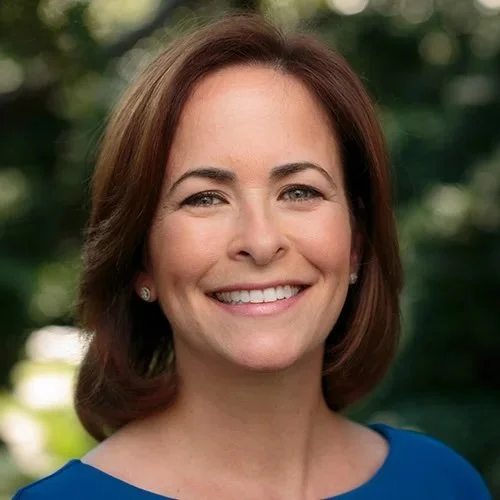
You really just have to do the thing that's going to suit your values and serve your purposes and feel right for you.
Summary
In this episode of Leadership Matters, Alan Fleischmann sits down with Kristen Silverberg, President and COO of the Business Roundtable, for an in-depth conversation on her remarkable career, from her Texas upbringing to influential roles in diplomacy, government and corporate America. Silverberg recounts her time clerking for the U.S. Supreme Court, serving in the Bush administration, working in Iraq and representing the United States in Brussels as Ambassador to the EU during pivotal moments, such as the global financial crisis and Russia’s invasion of Georgia. Now leading the Business Roundtable, she discusses the importance of preserving the free enterprise system, shaping economic policy and guiding corporate advocacy. Kristen also shares candid reflections on mentorship, leadership, communication and navigating the challenges of balancing a high-profile career with family life, offering inspiration and practical lessons for aspiring leaders.
Mentions & Resources in this Episode
Guest Bio
Ambassador Kristen Silverberg is President & COO at Business Roundtable. Prior to BRT, she was a Managing Director at the Institute of International Finance. She served in the George W. Bush Administration as U.S. Ambassador to the European Union from 2008 to 2009 and as Assistant Secretary of State for International Organization Affairs from 2005 to 2008. She also held a number of senior positions at the White House, including Deputy Assistant to the President.
Ambassador Silverberg served in 2003 in Baghdad, Iraq for which she received the Secretary of Defense Medal for Outstanding Public Service. She formerly practiced law at Williams and Connolly, LLP in Washington, DC and served as a law clerk to Supreme Court Justice Clarence Thomas and Judge David Sentelle of the U.S. Court of Appeals. She attended Harvard College and the University of Texas School of Law, where she graduated with High Honors.
Episode Transcript
Alan Fleischmann
Welcome to Leadership Matters on SiriusXM and at leadershipmattersshow.com. I'm your host, Alan Fleischmann.
I'm joined today by a distinguished leader whose career has spanned the highest levels of diplomacy, government, and corporate America, and who is a go‑to person for her thinking, strategy, and operations. Kristen is the President and Chief Operating Officer of the Business Roundtable, the leading voice for America's CEOs in Washington on issues that shape the nation's economy and competitiveness.
Under her leadership, the Business Roundtable has advanced major bipartisan agreements on infrastructure investment, workforce development, and pro‑growth tax policy, helping ensure U.S. businesses remain competitive in a rapidly changing global market.
Before joining the Business Roundtable, Kristen Silverberg served as the United States Ambassador to the European Union and held senior positions in the George W. Bush White House. She began her career clerking for Supreme Court Justice Clarence Thomas and went on to advocate for global finance as Managing Director at the Institute of International Finance.
Throughout her journey, Kristen has been a steadfast advocate for American leadership on the global stage and a trusted voice in times of global challenges. Her work continues to influence how business and government collaborate to address the defining issues of our time. I know of no leader who transcends public, private, and civil society sectors like she does.
I'm excited to explore Kristen's early influences, her career, and the many leadership lessons she's learned along the way.
Kristen, welcome to Leadership Matters. It is such a pleasure to have you on today.
Kristen Silverberg
Alan, thanks so much for having me on. I'm thrilled to be on the podcast. And you know how much I respect all the work you do with CEOs, with a lot of BRT members, in fact. So I'm delighted to be here.
Alan Fleischmann
Let's talk about the journey a little bit—where it all began. You grew up in Texas. Share a little bit of the early influences and experiences that shaped your career, your aspirations, and your leadership philosophy. Even mention the family dynamic a bit—if your parents were early influencers—and if there was a teacher or two along the way who kind of steered you in certain directions.
Kristen Silverberg
I was born in West Texas. My family lived in a small town called Fort Davis, on one side of the Davis Mountains. It's a town built around an old frontier outpost. We lived there until I was about five, and then we moved to Austin.
I attended Westlake High School, which is best known for its football team most years, although I was a cross‑country runner. I spent many hours running. When my friends were staying late and going out after the football games, I was always home early, getting some sleep before my race the next morning.
All of that was really formative. Growing up in the combination of West Texas and Austin gives rise to a sense of individualism, independence, and self‑determination. I think those values came, in part, out of that time.
Interestingly, my parents were not political at all. My father was a scientist, and my mother was a teacher. But I did have an early experience with politics with a congressman in Austin named J.J. "Jake" Pickle, who had been an LBJ protégé. When I was a high school senior, I interned for part of my day with Congressman Pickle.
That was a really interesting experience because he was very old‑school and constituent‑focused. He played a role in some big policy debates, but mostly he was known for being deeply committed to his constituents. I remember watching him and thinking, "This is how government ought to work." He thought of himself as a servant of the 10th Congressional District in Austin and spent most of his energies making sure he served the people of Austin effectively.
Alan Fleischmann
How early in life did you get intrigued by politics, and did you find yourself thinking beyond where you lived—nationally and internationally?
Kristen Silverberg
I don't know. I was always interested in law. I have journal entries from when I'm 12 years old saying that I'm going to go away for college and then come back and go to the University of Texas for law school. That was always in my sights.
My interest in politics evolved over time, including starting in college.
Alan Fleischmann
That's great. Any mentors along the way that you want to think about?
Kristen Silverberg
I had some amazing mentors. I had a teacher who was also my mock trial coach when I was in high school, named Dr. Woods. He was a really amazing person and very dedicated educator.
We formed a group to do mock trial competitions and went to Nationals. We lost at the end to this team from South Carolina. An excellent litigator from South Carolina beat us in the finals. I remember Dr. Woods having a lot of confidence in us and investing a lot of time in us. That was an important experience.
My cross‑country coach was also a great role model and an influence.
Alan Fleischmann
And your parents—what did they do? A little bit about the family home—brothers and sisters?
Kristen Silverberg
My father was what they called a "laser ranger." If you've seen pictures from the Apollo 11 mission, there's a little reflector the astronauts left on the moon. My dad's project would fire a laser at that reflector, bounce it off, and measure it, which gives you all kinds of data about continental drift and other things. That was his career for most of the time.
My mother was a special‑ed teacher and a wonderful influence on lots of people in our community.
My sister Lee, who's two years younger, now works at a consulting firm. She was a math person and works on a lot of retirement and health issues.
Alan Fleischmann
That's very cool. Then you went to Harvard, right? Anything you want to mention about high school before we move on? Tell us a little bit about your experiences at Harvard, and then later, about going back to Austin to the University of Texas Law School. Any specific moments that stand out as times when you were further directed or molded—professors, mentors, or experiences that really led to who you are today?
Kristen Silverberg
Harvard was an amazing experience, mostly because of the people I spent time with—my classmates and a lot of the professors.
I had one fantastic professor, H.W. Perry, who became a close mentor. He taught a constitutional law class that shaped a lot of my thinking and further persuaded me that I should head to law school.
Joe Nye, who passed away recently, taught the class that really sparked my interest in international affairs. That was formative.
Even some of the professors in areas that were way outside my eventual field were very influential. I remember a class with E.O. Wilson, the famous sociobiologist—and a controversial figure. He was an ant expert, but he believed that human behavior is the product of evolution and environment, and that a lot of things we attribute to faith and morality are really genetic adaptations. That wasn't my belief, but being taught by someone so interesting, provocative, and knowledgeable made a big impression. I still reflect on that class.
Alan Fleischmann
Did he write about broken windows, or am I confusing him?
Kristen Silverberg
No, that was a different Wilson—James Q. Wilson.
Alan Fleischmann
You're saying that from that experience, it didn't change your perspective, but it let you see into the eyes of others and their perspective?
Kristen Silverberg
Exactly. I've reflected on that a bit as we watch the current debate about the role of universities. On one hand, academia needs to make sure it's open to diverse viewpoints and not just a forum for different schools of thought on the left. But I also learned a lot over time from people who came from very different places than I did.
Alan Fleischmann
Did you go right from Harvard to law school?
Kristen Silverberg
I took a year off and worked. I did a couple of various jobs, and then started the next year at UT, as planned.
Alan Fleischmann
And did you love law school as much as you loved college?
Kristen Silverberg
I really loved law school. I had amazing professors. One in particular, Sam Issacharoff—now at NYU—was a close mentor. I took every class he taught on campus. I usually just signed up for the class and then figured out the subject matter later.
He was a great mentor and advised me a lot on my law review note, which I've been thinking about recently because the topic was gerrymandering—or "Gerry‑mandering" in the traditional pronunciation. I've been thinking about that as we watch the current national debates.
Professor Issacharoff played a big role in persuading Judge Sentelle, the Court of Appeals judge I clerked for, to hire me coming out of law school.
Alan Fleischmann
That's very cool. I don't think in all the years I've been pronouncing "gerrymandering" and talking about it, I ever knew that was not how you're supposed to pronounce it.
Kristen Silverberg
It comes from Elbridge Gerry, the governor of Massachusetts. There was a salamander‑shaped district in Massachusetts, and a journalist quipped that it was a "Gerry‑mander." Justice Scalia used to pronounce it that way.
Alan Fleischmann
That's amazing. Then you clerked at the Supreme Court with Justice Thomas, as I mentioned in the opening. How long did you do that?
Kristen Silverberg
Supreme Court clerkships are one year.
Alan Fleischmann
They're really hard. Not that it was easy to get into Harvard or UT Law, but it's really hard to become a clerk at the Supreme Court.
Kristen Silverberg
The recommendation of your Court of Appeals judge matters a lot. I had clerked for Judge David Sentelle, an amazing North Carolinian and larger‑than‑life person. He recommended me to Justice Thomas, with whom he had worked when Justice Thomas was on the D.C. Circuit. That recommendation mattered a lot, and Justice Thomas and I really hit it off.
Alan Fleischmann
How was that experience?
Kristen Silverberg
It was amazing, and it continues to be amazing because Justice Thomas stays in close touch with all of his law clerks. It was an incredible chance to see behind the scenes of this institution—to understand how the Court tackles issues and the dynamic between the Justices.
I remember being up at the Court late with other law clerks, hashing through issues and various opinions. Understanding the process of how an opinion gets put together was invaluable.
Justice Thomas in particular is so warm and kind—to his law clerks, but really to everyone at the Court. That made it a particularly important experience for me.
Alan Fleischmann
Do clerks who are working for different Justices spend time together as well?
Kristen Silverberg
Oh, yeah. I've stayed in touch with a lot of the people I clerked with, and it was an interesting year. Ketanji Brown Jackson was there that year; of course, she's on the Court now. Many people went on to interesting roles—Tim Wu, a famous antitrust expert; Joel Kaplan, who works at Meta; Bill Burck, who has represented Harvard in litigation. A lot of interesting people.
Alan Fleischmann
There are many things people don't understand about what happens behind the scenes that would be critical for people to know. We spend a lot of time on this show talking about the founding fathers and mothers of this country and trying to re‑instill, with the 250th anniversary coming up, how we remind ourselves what matters, what's sacred, and what makes America that example and experiment. One of those institutions is the Supreme Court, by far, and there's a lot to learn.
Kristen Silverberg
It's absolutely true. Having worked at the State Department and served overseas, there's no question in my mind that one of the most important things that distinguishes the U.S. from a lot of countries is our strong commitment to the rule of law—to institutions that treat everyone equally, whose decisions are tied to consistent laws and principles.
That predictability is part of what has secured a strong and prosperous U.S. economy—the stability of our rule of law. There's no more important topic to our democracy.
Alan Fleischmann
Maybe one of these days we'll have a Supreme Court scholar—or maybe even you—come back and talk about some of the most critical cases in history. People don't always realize how pivotal they are to our daily lives.
Then you went to the Bush administration. Was it right away, or was there a gap?
Kristen Silverberg
I went home to the campaign. My clerkship ended in July of 2000. I asked the Justice for advice: should I go back to a law firm—I had practiced at Williams & Connolly for a couple of years, which was a great experience—or should I move back to Austin to volunteer on Governor Bush's campaign?
The Justice gave me the very good advice to go home and work on the campaign. So I showed up in Austin that summer, volunteered on the policy group, and spent the rest of that time basically until election night. Then I went to Florida for the recount. At the end of the recount, I was hired by Josh Bolten and Andy Card to work in the Chief of Staff's office.
Alan Fleischmann
That must have been an extremely exciting and unprecedented time. In Florida, were you part of the James Baker team that went down?
Kristen Silverberg
I was in Palm Beach, not Tallahassee, where Secretary Baker was. I was on a recount team in Palm Beach attached to John Bolton, with whom I later worked at the State Department. We sat there counting chads for hours on end, essentially until the recounts ended.
Alan Fleischmann
And then you went to the White House. What was your job in the Chief of Staff's office?
Kristen Silverberg
I was a policy assistant in the Chief of Staff's office. There were two of us working for Josh Bolten, who was then the Deputy Chief of Staff. We essentially split up the world. My colleague took half the policy issues, and I took the other half.
We would back‑row every senior‑level meeting on those topics. If the National Economic Council was meeting in Larry Lindsey's office, I'd go sit in the back row. If there was a meeting in the Roosevelt Room with the President, I'd sit in on that. We'd go into Oval Office briefings, if appropriate.
As a very young person, I had this amazing seat watching how the White House and the federal government function. I stayed in that role, took a sabbatical to go to Iraq for six months in 2003—on loan to the Coalition Provisional Authority when Ambassador Bremer was running it—and then came back as the Deputy Domestic Policy Advisor. After the reelect, I moved back to the Chief of Staff's office to work as an advisor to the Chief of Staff.
Alan Fleischmann
There's a lot there. Going to Iraq must have been a tough decision.
Kristen Silverberg
I wanted to do it. I had been in the White House on 9/11 and had been evacuated with all the other staff. I spent four or five months afterwards focused on some of the post‑9/11 domestic consequences.
Some of those issues were incredibly difficult. I remember the discussions when New York City ran out of morgue space and working with people to get Department of Transportation clearance to bring additional morgues into the city. We worked to make sure we tracked the victims' names effectively, and on issues like victim compensation and health questions for first responders—very painful things.
I was not involved in the issues around the war in Afghanistan. I was focused on the terrible domestic consequences. That experience persuaded me that some of the most important things we had to tackle as a country were going to be outside our borders.
Up until that point, I'd focused on domestic policy—health care and economic policy. That experience persuaded me that I wanted to focus on some of the challenges we were facing overseas. When the President decided we were going into Iraq, I volunteered to be the White House person on loan to the effort.
Alan Fleischmann
Did you know you were going for six months, or was it open‑ended?
Kristen Silverberg
It was open‑ended. I went over when Ambassador Bremer did. While I was there, the Deputy Domestic Policy Advisor, Jay Lefkowitz, decided to leave, and they asked me to come back to do that job. That's why I came home.
Alan Fleischmann
Then you came home and later went back to the Chief of Staff's office.
Kristen Silverberg
I stayed in the Domestic Policy Council until the reelection. After the reelection, there was a reorganization. Andy Card, who was then the Chief of Staff—Josh had already moved over to be OMB Director—asked me to come back to the Chief of Staff's office as a policy person.
The Chief of Staff's office decides what's ready to go to the President. There's a lot of work happening in the policy councils to prepare decisions for the President, and the Chief of Staff's office follows that and decides, "The issues are honed enough; the staff‑level work has been done; the positions of the agencies are clear; we now have a decision that's teed up for the President." My role was to help figure out when an issue was ready for the President and how to present it to him.
Alan Fleischmann
One of my joys is that I've gotten to know President Bush since he left office. When you talk to people like yourself who worked for him, he was a very disciplined, organized president—probably among the most disciplined and organized. Maybe Eisenhower and Bush 43 are the two who insisted on discipline, preparedness, and consistency in how they managed. That translates very easily to private‑sector leadership.
I've always wanted him to write a book about that, because when you talk to people like yourself, that's what you did. You were the depository, the analyst, the prioritizer—figuring out how to get all this material from different councils into a form the President wanted so he could make his decisions.
Kristen Silverberg
You're so right about President Bush. Our current BRT Chair, Chuck Robbins, the CEO of Cisco, reminds me of President Bush in that sense. They're similar: if you're on time to a meeting with them, you're ten minutes late. They're ready to go and very efficient decision‑makers.
They expect issues to be teed up clearly but are very comfortable making decisions. Both come across as laid back, which can disguise real discipline in how they approach issues. I think it would be a great idea for President Bush to write a guide for decision‑making.
Alan Fleischmann
President Eisenhower always had the attitude that by the time something got to him, if it couldn't be done in a one‑page memo, too many things hadn't been considered. There are so many similar habits in how President Bush expected information to flow and decisions to be made. That part of him isn't widely understood, and it's something we should yearn for in leaders—understanding the power of decision‑making based on disciplined, organized information that goes through trusted people like you.
Kristen Silverberg
The other thing about him that I really valued is that he wanted information straight. He did not like sycophants. He didn't want it sugar‑coated.
Even as a very young person—as a 30‑year‑old—I had meetings where I was telling the President of the United States that I disagreed with him about something. I did it with enormous respect and deference, but he was very comfortable having someone say, "I wouldn't do it that way, and here's why."
That's another important characteristic of good leaders, including CEOs. They're not afraid of disagreement or negative information. They don't shy away from bad news.
Alan Fleischmann
And they seek out people who are going to be open and look out for the outcome and the right answer, not just their own positioning. It's lonely at the top, as you know, and gets lonelier. Knowing that people have the courage to speak out is a great comfort to leadership.
Did you go right from there to Brussels?
Kristen Silverberg
No, I went to another job at the State Department. When Secretary Rice moved from the National Security Council to the State Department, I asked if I could go with her. As I mentioned, after 9/11 I decided I wanted to spend time on national security issues.
Dina Powell McCormick, who was also going to State, and I talked about various options. I ended up in the role of Assistant Secretary for International Organization Affairs, which works with our ambassadors at the UN, including the Permanent Representative in New York—at the time, John Bolton.
Alan Fleischmann
How was that?
Kristen Silverberg
It was a great job. It was amazing because the role has a global remit. I spent a lot of time on Iran nuclear issues, Lebanon, and peacekeeping issues in Africa. I dealt with my P5 counterparts—the Europeans, Russians, and Chinese. It was an extraordinary first State Department role.
Alan Fleischmann
And the people you worked with—it sounds like a great constellation.
Kristen Silverberg
It was. Ambassador Bolton was a very experienced diplomat, extremely smart, and a tough negotiator. I felt good about the outcomes of many of our efforts—some of the UN reform work, and certainly work on Iran nuclear issues and the Security Council resolutions.
Alan Fleischmann
When you think about your life, did you say, "I want to go to the State Department; I want this experience," or were some of those opportunities you were open to as they presented themselves? How much was you grabbing at it as part of a plan versus being sought after?
Kristen Silverberg
It was a bit of both. For the Assistant Secretary job, I definitely put my hand up. I said I wanted to move over to State and was grateful the Secretary supported that.
After I'd been at State a few years, the job in Brussels as Ambassador to the EU opened up, and they came to me with that. I don't really know how that happened. They just contacted me to say the President wanted to nominate me. I said, "Of course I would want to do that."
Alan Fleischmann
That's a big deal.
Kristen Silverberg
It was. It was amazing.
Alan Fleischmann
Once you were confirmed by the Senate, you went to Brussels. Tell us a little bit about that and how long you were there.
Kristen Silverberg
I was confirmed in 2008 and served for the remainder of that year—until Inauguration Day in January 2009. It was a short but fascinating tenure. The financial crisis began while I was there, and there was a lot of discussion about what the EU regulatory response would be.
Russia invaded Georgia—that was a big focus, working to ensure the U.S. and Europeans were aligned on responses. There were ongoing discussions about Iran nuclear issues. And there were regulatory issues: Brussels plays a geopolitical role, but mostly it's a regulator. I spent time on chemical regulations and other policies that affect how U.S. businesses operate in the EU. It was a great experience.
Alan Fleischmann
Often when people have that extraordinary experience, they're forever called "Ambassador." But there's something about you—a combination of confidence and humility—also true of Josh Bolten and President Bush. You could easily be "Ambassador Silverberg" in every conversation, but you tend to be "Kristen." Is that deliberate?
Kristen Silverberg
I told my husband he could call me "Your Excellency."
Alan Fleischmann
Good answer.
It was probably an intersection of all the things you do today—focusing on the power of the nonprofit world, the public sector, and the corporate world at that intersection. You saw how diplomacy can be corporate and commercial as well as public‑policy related.
Kristen Silverberg
That's right. It was an interesting window into how corporations deal with advocacy.
When the financial crisis started, I said, "We should call in the big U.S. financial institutions and ask what they're telling the European Union." Many didn't have a full‑time role in Brussels. They had a part‑time person in London or no one at all. You can't imagine that today—no financial institution or major U.S. company is unconcerned with how they engage Brussels or Washington.
I learned a lot about how U.S. companies can work with policymakers to ensure they understand their business and the implications of decisions for their ability to thrive and compete—how you persuade government on issues central to your business.
Alan Fleischmann
Did you have to build that out in your leadership when you were Ambassador—bringing in the non‑obvious people who needed to be at the table but didn't know where to go?
Kristen Silverberg
Yes, that's an important role for the State Department in commercial diplomacy—making sure U.S. companies and nonprofits have a seat at the table.
Alan Fleischmann
Did you serve to the end of the second term?
Kristen Silverberg
Yes. I was in all eight years.
Alan Fleischmann
When you were leaving, what were you thinking about your next steps? Were there role models you kept in mind—people who'd served eight years—and people giving you advice?
Kristen Silverberg
There were, although my position was a bit different. I got married in 2008. My husband was also in the Bush administration, at the National Security Council. He commuted to Brussels for a few months, but we really wanted to have kids.
As soon as I left government, I stayed home to have our boys. That was a different path—doing that for a few years after government.
Alan Fleischmann
Probably perfect timing. Then you went to the Institute of International Finance, as I mentioned. Was that a few years later?
Kristen Silverberg
Yes, that was a few years later.
I know you've been involved in groups talking about women in leadership. I had that period between leaving the State Department and deciding to stay home, and then later going back to IIF. That was a bit frightening, because all the advice was, "You can't take time off; it will handicap your career." Lean In came out during that period, and I remember thinking, "Am I making a mistake by not leaning into my career?"
In hindsight, for me, that was absolutely the right call. That period at home was really important. When I went back to work at the Institute of International Finance, I was ready. I'd had time at home with the boys and felt I'd figured out how to be a mom.
One takeaway is that nobody can give you very good advice on this. You have to do what suits your values and feels right for you. When I was ready, I went back to work at IIF.
Alan Fleischmann
It's tricky, because we sometimes rewrite our histories and priorities and forget what drove our earlier decisions. It's important to remember the reasons. Clearly, it didn't hold you back, and you also had a consequential journey up to that point.
Going into high‑level corporate advocacy—you had a background in law, government, and diplomacy. All of that prepared you for your work at IIF. Tell people what the Institute of International Finance is, and your role there.
Kristen Silverberg
The Institute of International Finance is an association of financial institutions from about 80 countries. It's incredibly global and plays an important role in research on political‑economy issues.
There are economists focused on Africa, the Middle East, Europe, China, and so on. A lot of the work is helping financial institutions understand key economic conditions, including those driven by political risk.
That drew on my State Department experience understanding political risk, but the new part was translating that into insights for investors and financial institutions. A group of us would brief investors on what was happening in various places—often Washington—and what that meant for their business.
Alan Fleischmann
How long were you there?
Kristen Silverberg
About five years. I moved over to BRT in 2019.
Alan Fleischmann
Was that a natural move at that point? With Josh Bolten there, it's like bringing the band back together.
Kristen Silverberg
That was a big draw—the opportunity to work with Josh again. He's an amazing leader.
There was also so much happening in the U.S. I remember a survey in 2019 that said young Americans thought socialism was preferable to capitalism. That struck me. Something was happening in how we understand our own economic system.
Criticism of capitalism from the left isn't unusual, but there was a new growing movement on the right that was suspicious of free enterprise. Business Roundtable is a 50‑year‑old institution made up of the most important American companies. Josh, as CEO, and Jamie Dimon, who was then Chair, said they wanted to understand and navigate these issues to preserve the free‑enterprise system.
That felt important, and I was excited to do it.
Alan Fleischmann
Was the Business Roundtable at an inflection point in its 50‑year history?
Kristen Silverberg
In some ways. Jamie, who was Chair from about 2017 to 2020, was really transformational. He put a lot of his energy, commitment, and patriotism into making sure BRT was set up to play a big role. That period was important.
We've had incredible Chairs since Jamie: Doug McMillon of Walmart; Mary Barra of General Motors; and now Chuck Robbins of Cisco. This has been an extraordinary time for the organization.
Alan Fleischmann
When you look at the roster of members, the board, and the Chairs, it's extraordinary—very thoughtful leaders with high energy and high purpose.
Kristen Silverberg
I completely agree. And there's a lot of intellectual curiosity. When you go to a meeting with Jamie, for example, you're not listening to him lecture you. He's firing questions: "What about this? How does that work? How do you understand that?" There's a real appetite for taking on things with seriousness.
Alan Fleischmann
Are there consistent traits and qualities among these very different CEOs and board chairs—and you—that you'd say are common, even with different personalities and perspectives?
Kristen Silverberg
We talk about this with the BRT board when they discuss what kind of CEO would be a good BRT member. There are some consistent themes.
A strong BRT member is a patriot. Our mandate is to advance a strong U.S. economy and economic opportunity for Americans, so it's someone who thinks about the strength and prosperity of the U.S.
It's someone with a long‑term perspective. Our companies don't come here to talk about narrow, parochial issues. It's not "my company has this pain point." It's "what economic policies will produce a strong U.S. economy in the long term?" It has to be someone who can set aside parochial issues a bit.
It has to be someone serious about public policy who cares about engaging with policymakers, which is a lot of what we do. Those are some common characteristics of active BRT members.
Alan Fleischmann
You mentioned Jamie Dimon comes in asking lots of questions. Many leaders you work with—and you—have an insatiable curiosity about learning. Is that something you've also discovered as a common trait?
Kristen Silverberg
Absolutely. There are extraordinary people in the BRT membership—in terms of intellectual heft and emotional intelligence. What really stands out is their commitment to engaging on policy issues in a serious way. I find that very admirable.
Alan Fleischmann
It's such an important time to have that assemblage. When I talk to BRT members and CEOs, one of the great halo effects of being associated with BRT is that they get to be together with other CEOs. They have incredibly busy lives, but when they come to BRT, they feel they learn from the discussions. They share experiences and challenges across sectors and discover opportunities.
I think that's the secret sauce: you get a pause button that leads to action and camaraderie.
Kristen Silverberg
I completely agree, and in some ways that's even more important now.
We're living in a time of enormous change—economic, technological, and policy change. Many fundamentals of being a CEO are still similar—you focus on producing a great product or service, making money for shareholders, leading your employees—but you're also living in incredible uncertainty and flux.
Many CEOs in our membership have had uncertainty and flux for their entire careers: the dot‑com bubble, the financial crisis, pandemics, inflation, massive geopolitical change, tariffs, supply‑chain shocks. For many, there's never been an extended "normal" period. This is a generation of leaders that thinks of constant change as the baseline.
They're navigating disruption. If you're leading in a time like that, understanding how your counterparts are thinking is particularly valuable. They're dealing with technological change from AI, issues around tariffs and public‑private relations, and geopolitics. They want to understand how their counterparts view these issues.
A big part of what BRT is about is helping CEOs navigate this period of unprecedented change.
Alan Fleischmann
Are you optimistic about the future? You mentioned geopolitical challenges and the incredible speed of disruption—mainly AI, but also climate change, cultural changes, multiple stakeholders with different perspectives. Does that leave you more optimistic about the human element in leadership, or does it make you feel threatened? Is the human element in leadership threatened? How important is it to have humanity and EQ at the helm?
Kristen Silverberg
I think it's more important than ever, and I'm very optimistic about it.
In 2019, Business Roundtable put out a "Purpose of a Corporation" statement. It essentially said: if you want to have a great company and be a great leader, you can't just focus on your share price. Your share price is essential—making money for shareholders is a critical part of your job—but if you really want to run a great company, you have to focus on putting out a great product or service and keeping the trust of your customers.
You have to be a great leader of your people, invest in and earn the trust of your employees. You have to have strong relationships with your suppliers, including small‑business suppliers. You have to be a responsible member of your communities, and so on.
That's still absolutely the case. A great CEO finds ways to do all of those things, and most involve a crucial human element. They aren't things that can be engineered away. They require earning and deserving the trust of the people who support your business. The human element is as important as it's ever been.
Alan Fleischmann
I'm happy to hear that, because when you think about doomsday predictions of AI, there are messages that make you feel augmented and more powerful, and others that make you worry about where the human being and humanity are in all this.
It will take real leaders who want to speak to real people and ensure we're delivering for people. I think BRT is an important place to have those conversations, and CEOs are having them—to turn fear into fierceness. But there are a lot of people who are concerned.
Kristen Silverberg
I'm also very optimistic, broadly, about the U.S. and our long‑term prospects. We have a privileged position because of the strength of our economic model and our ability to innovate and adapt. In a time of change, a free‑enterprise model has a lot of advantages.
We also live in a country with abundant energy, food, and water, and solid demographics. All of those will support a strong U.S. economy. But the biggest advantage we have is what we talked about earlier: a free‑enterprise system supported by the rule of law.
Front and center for Business Roundtable is making sure we preserve that system. There's growing support—including on the right—for a bigger role for government in the U.S. economy. We think that's incredibly dangerous.
Free‑enterprise systems innovate more, are more responsive, and better support prosperity. Government is never going to be able to adapt or innovate in the same way. If government is making most decisions about capital allocation, that will slow and handicap the U.S. economy.
So, for us, the key question is: how do we preserve the free‑enterprise system the U.S. has enjoyed, which has led to a strong economy, while preserving the appropriate role for government—supporting the rule of law, but not making the critical decisions about capital allocation?
Alan Fleischmann
Well said. When you think about the principles that guide you—and that guide the CEOs you interact with—what are those principles? And in your own day‑to‑day, are there practical tricks of the trade in how you manage your time—the most important currency we have—that you'd share?
Kristen Silverberg
I think about this every day because my temptation is always to get in the weeds. I'm a perfectionist. I want to dig into the document and make sure all the t's are crossed and the i's are dotted. But in this role, that's not my job.
My job is to keep our team focused on our long‑term objectives. I do some time‑mapping—comparing my schedule against our longer‑term, critical objectives—and it frequently shows I'm spending time on the wrong things, and then I have to reorient.
My friend John Hillen just wrote a great book about business strategy. I had him come in and talk to BRT about how we identify our long‑term plan. I also like to take time to focus the entire organization on strategy issues, rather than just the urgent day‑to‑day. That's been a good opportunity to reset and make sure we're keeping our eyes on the long‑term horizon.
Alan Fleischmann
That's great. And then there's the humanity part—the power of communication, coordination, collaboration, and consideration when you're dealing with people you're managing and trying to inspire them to feel as responsible for outcomes as you are. It's hard to do if you're a perfectionist. How do you manage that? Because if you grab your laptop and do it yourself, you can't scale.
Kristen Silverberg
That's right. One of the most important things our board has supported is putting together a really great team at BRT, top to bottom. We have some excellent professionals.
A big part of my role is empowering them to do their jobs effectively, not trying to do their jobs for them.
Alan Fleischmann
Is there one question I didn't ask you—about you as a leader, as a role model? As a father of daughters, I should say that you're also an extraordinary role model for women. You're the best at what you do, gender aside, but for women who are trying to navigate a career that might take them through public, private, and civil society sectors, there are not many who've accomplished what you have. Is there one thing you'd want to leave with this audience?
Kristen Silverberg
First of all, that's incredibly kind.
We have some amazing women leaders at BRT, and I've learned a lot from them. You know many of them—Kristin Peck of Zoetis, Jane Fraser of Citigroup, Beth Ford of Land O'Lakes, Judy Marks of Otis, Mary Barra of GM. Some incredible women I've been able to observe and model.
I know you've had Dave and Dina on to talk about their book on mentoring, which gave me great insights and inspired me to call some of my former mentors and say thank you. A great part of their book is thinking about how you express gratitude to the people who supported you and how you, in turn, inspire and support others.
That's been a great thing to focus on at this stage of my career.
Alan Fleischmann
That's a wonderful message for this audience—to curate mentors. People want to be mentors, but you have to cultivate those relationships and stick with them, whether they're your immediate boss or your boss's boss. Sometimes people say, "You're my mentor," and don't do anything about it. Deepen that relationship so that loyalty and devotion are two‑way—it's powerful throughout life.
Kristen Silverberg
I agree. I was so thrilled you asked about the people who influenced and mentored me, because it's an opportunity to recognize them.
Alan Fleischmann
I hope some of them are still around to listen to this episode.
Kristen Silverberg
Absolutely. I'm going to send it to Judge Sentelle, for sure.
Alan Fleischmann
When people look at their journey, what they want to know is that they affected change in others and through others.
This has been great. You've been listening to Leadership Matters on SiriusXM and at leadershipmattersshow.com. I'm your host, Alan Fleischmann. We just spent the last hour with Kristen Silverberg, the President and COO of the Business Roundtable.
It has been such a pleasure to have you on the show—to learn about your early influences, your extraordinary journey, the lessons you've learned along the way, the mentors who've played a role in your life, and to know that we should be optimistic as well—that if we do it right and prioritize what matters, we can make sure the years ahead are the best. That's a powerful message.
Thank you.