Helle Thorning-Schmidt
Former Prime Minister, Denmark
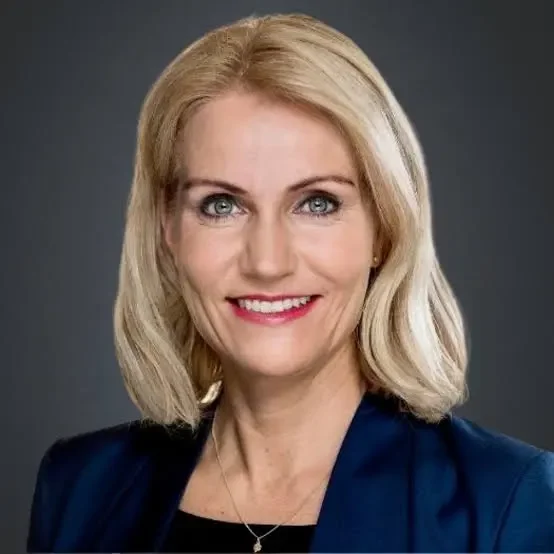
That instilled in me this idea that change was not coming from everyone else. I had to actually step up and be the change myself.
Summary
In this episode of Leadership Matters, Alan Fleischmann sits down with Helle Thorning-Schmidt, Denmark’s first female Prime Minister and former CEO of Save the Children International. Helle reflects on her journey from a modest upbringing in Copenhagen to the highest office in Denmark, her experience leading during the global financial crisis, and her time at the helm of one of the world’s most influential NGOs. She shares candid lessons on resilience, consensus-building, and bridging divides across politics, business, and civil society—offering a vision of pragmatic, values-driven leadership for the future.
Mentions & Resources in this Episode
Guest Bio
Helle Thorning-Schmidt has an extensive background spanning politics, international relations and business. In 2017 she was named as one of the world’s greatest leaders by Fortune magazine.
As Prime Minister of Denmark from 2011-2015, Helle steered Denmark through a difficult financial crisis while reducing child poverty and increasing spending on education. She also served as leader of the country’s Social Democrat party for a decade, and was the first woman to hold both positions.
Following her term as PM, Helle was the Chief Executive of Save the Children, overseeing the work of 17,000 staff in 120 countries to reach around 50 million children every year in some of the most difficult and challenging contexts. She was deeply engaged in highlighting the humanitarian crises in Yemen and Syria, and the Rohingya refugee crisis.
Ms Thorning-Schmidt remains deeply engaged in these geopolitical issues as a member of several foreign policy think tanks, including the US Council on Foreign Relations, the European Council for Foreign Relations, and the Atlantic Council International Advisory Board. Helle is also a member of the Berggruen 21st Century Council.
In 2017, Helle was a co-chair of the World Economic Forum meeting in Davos, and is on the board of the Schwab Foundation for Social Entrepreneurship. Today Helle uses her deep political and international expertise to advise a range of businesses and not-for-profit groups.
Helle is non – Executive Director for a number of Boards - Vestas, one of the world’s leaders in sustainable energy; DJE Holdings, a global communications firm that partners with businesses and organisations to evolve, promote and protect their brands and reputations; Safelane, a global leader in clearing landmines and the explosive remnants of war; Carsøe, a leading manufacturer of retail, customised, and OEM solutions for key suppliers of food processing equipment across the world; and VISTA Equity Partners, an American investment firm focused on financing and forwarding software, data and technology-enabled startup businesses. In 2020 Helle was appointed Co-Chair of The Oversight Board created to help Facebook answer some of the most difficult questions around freedom of expression online; as well as Chairman for the Danish Football Union’s Governance Committee.
Also in 2020, Thorning-Schmidt was appointed by the World Health Organization's Regional Office for Europe to serve as a member of the Pan-European Commission on Health and Sustainable Development.
Helle devotes much of her time to defending and renewing progress, social justice, and democracy. As a strong champion of women and girls’ rights throughout her time in government and at Save the Children, she continues to remain passionate about women’s empowerment.
Helle was previously a member of the European Parliament. She has a Master’s Degree in Political Science from the University of Copenhagen and a Master’s Degree in European Studies from the College of Europe in Bruges.
Episode Transcript
Alan Fleischmann
Hello. Welcome to Leadership Matters on SiriusXM and on leadershipmattersshow.com. I’m your host, Alan Fleischmann. Today I have the honor of welcoming Helle Thorning-Schmidt, one of the most dynamic and impactful leaders of our time. Helle’s journey is a groundbreaking and inspiring one. Born and raised in Denmark, she rose through the ranks of public service, beginning her career with the Social Democrats and the European Parliament, before shattering glass ceilings as Denmark’s first female prime minister. During her tenure, she navigated some of the most challenging political and economic moments in Europe, balancing national priorities with global responsibilities. After leaving public office, Helle took her leadership to the world stage, serving as CEO of Save the Children, where she championed the rights and welfare of millions of children worldwide. Today, she continues to shape global dialogue as a board member and adviser to leading companies and organizations tackling issues from democracy and human rights to technology and responsible business. I know of no one who has had more important leadership responsibilities across public, private, and civil society. Helle is known not just for her political and organizational achievements or her wisdom, but for her ability to lead through complexity, build consensus in polarized environments, and inspire others through her values-driven approach. I’m excited to explore her early influences, her experiences in the highest levels of government and nonprofit leadership, her vision for the future of leadership and global collaboration, and the many lessons in leadership she’s learned along the way. It is such a pleasure to have you on the show.
Helle Thorning-Schmidt
Thank you for having me, Alan. What an introduction.
Alan Fleischmann
I meant every word. I could have kept going. I didn’t do it justice. Let’s start a little bit with your early years. Tell us what it was like growing up: your family, your parents, any influencers. I’ve got to imagine parents probably fit that bill too, but also mentors along the way from your school years who inspired you. And looking back, can you see elements of destiny, or not really?
Helle Thorning-Schmidt
Honestly, no. Just a few words of introduction to my background, because it’s such a normal background. I come from what you might call the wrong side of the tracks in Copenhagen. I come from a divorced family, so I was brought up very much by my mom from when I was 10. I went to a completely public school system—meaning not private—and just got educated like everyone else. I spent a whole lot of my childhood singing and dancing, going to choirs and dance lessons, and I was a very happy child in many ways.
But at some point I realized that I also had a voice. I got good grades in school; I could think. My dad always taught us children to think, ask questions, and be critical. I suddenly found out that my voice could be used to change things in my local school and wherever I was. I dared to raise my voice and use it to change things, very much encouraged by my mum and dad. If I came home complaining about something that was wrong in school, they would turn to me and say, “So, what have you done about it?” Putting that responsibility on an 11‑year‑old—asking, have you used your voice to try to change things?
I think that instilled in me this idea that change was not coming from everyone else. I had to step up and be the change myself. I have tried to change things wherever I’ve been—in the educational system, in my work, wherever I am I try to change things for the better. That’s where it comes from.
Alan Fleischmann
I love what you said. When I think of you, what I admire is your enormous interest in people and your incredible curiosity. When you said, “What are you doing about it?”—you became the person who says, “I have a voice, I ask questions, I find answers.” That is a muscle one has to embrace or develop. You naturally came with it, but you were encouraged. I love that your parents said, “Why not you?”
Helle Thorning-Schmidt
Yeah, “Why not you?” That was the message to me. I’ve been in millions of situations where I was nervous. People, particularly young women, often look at female leaders and think, “She can never be nervous if she stands up and gives a speech.” Obviously, I’m older now, so I’ve kind of stopped being nervous. But when I was younger, doing political work or at university, I always had that little voice: “Will I be clever enough? Will what I’m saying be good enough?”
I always felt that you need that little bit of pain and anxiety to take the floor and have an opinion and let that opinion be the change. That was instilled in me from a very early age. I was brought up in quite a democratic family—it sounds like a weird concept, but even though I’m the youngest of three, I always thought that I could have a voice, that my voice mattered, even in my family.
Alan Fleischmann
And that’s brilliant, because it’s not always the case. People often say, “I can’t be the expert, I’m not enough, someone must know better than I do.”
Helle Thorning-Schmidt
Exactly. We have to familiarize ourselves with the feeling that there will always be things others know better than we do. I sit on a number of boards now, and I can guarantee you people there know things better than I do. But you still have to think, “Well, I’ve got a place in this room. I’ve got a voice. I’m a clever person, so I have something to offer.” That has always brought me to the next step.
There was nothing in my cards that suggested I would one day go into politics and be prime minister. I had no politicians in my family, no connections, nothing of that sort. I basically had to find my own road to that.
Alan Fleischmann
And you found it and found your passion. In your case, your purpose became this passion for service and leadership. Did your voice lead you into leadership roles when you were at the University of Copenhagen or the College of Europe?
Helle Thorning-Schmidt
Yeah, it did. At the University of Copenhagen, I got involved in leadership and became leader of the student council. That’s when I really started figuring out, “I can actually be part of something.” I’m also an extremely hard worker. None of us who are in leadership positions—no matter where—got there by luck. Luck follows people who are very hard working. I always worked really hard for grades, for positions, for having a voice.
One thing I always say to people is: it is okay to be nervous. It’s okay to feel discomfort, because nothing comes from an easy path. You have to be in discomfort, you have to be out of your comfort zone to get somewhere. I’ve always felt that I didn’t die even when I was out of my comfort zone.
Alan Fleischmann
When you ran in college, did you automatically win everything you ran for?
Helle Thorning-Schmidt
I did not. In university, I did, but later on I stood for seats and didn’t win. I’ve lost. I’ve stood in elections and not won. I have actually tried not winning, which is very helpful, because you think, “I’m going to die of embarrassment, everyone will look at me.” I’ve tried all those things, and that also makes you stronger.
Alan Fleischmann
I think that’s true. People fear losing and don’t realize that you have to run to win. Once your name is out there, that gives you a certain currency and power because you’re in the arena.
Helle Thorning-Schmidt
Exactly, you’re in the arena. You have to be brave enough to understand that you can lose if you run for election. I’ve run for national elections where I didn’t win. If you run for anything, you have to face that fear and be comfortable with it. Otherwise you don’t have the courage. You have to say, “I’m not going to die from this. I might get a little bit broken inside and out, but I won’t die from it, so I’ll do it anyway.”
One of the reasons I stood for really high posts—for example, when I stood as leader of my party, which was really out of the blue—was that I wasn’t scared of losing. That was one of the reasons I won.
Alan Fleischmann
Yeah, because you leaned in. You did it. I’m curious: when you were in high school or university, were there any mentors who stood out?
Helle Thorning-Schmidt
Not really. Don’t forget, I’m from a generation of women who didn’t have that many women to look up to. There were a few women in my party that I thought were cool, but not many. I had great teachers and adults who looked out for me, but it was only later, when I started working and building a proper network, that people started looking out for me, helping me, recommending me for jobs, all the things you also need.
That’s also a skill—to build those networks, talk to people, and get people on your side all through life. I’ve been pretty good at doing that.
Alan Fleischmann
And having the courage to ask people to believe in you and help you. People don’t always want to go out and help others. Sometimes it takes someone to reach out and say, “Believe in me, I need your help. This is what I need.”
Helle Thorning-Schmidt
That’s what I want to say to younger folks now: they need to really try to use whoever they might know—in their neighborhood, their community, wherever—to get connections and contacts. I honestly came into politics with zero connections to anyone, so I had to build them. That’s also a skill. I’m very proud of myself for having built all that, but it comes from my own hard work.
Alan Fleischmann
Was your experience at university, when you ran for student body leadership, what gave you the idea that you wanted to run for politics in general?
Helle Thorning-Schmidt
Not that early. It gave me the idea that I wanted to challenge things and change things, and that I could be part of that change. It gave me the idea that I could be a leader. The first time that enters your head, it’s a bug. You think, “I can lead things, I can do things, I can get other people with me.” That bug has never left me—that I think of myself as a leader.
As soon as you start thinking of yourself as a leader, you start thinking, “Okay, I’m a member of this party—can I lead it? Can I do better than the people who are there? I might give it a go.” And you feel responsible.
Alan Fleischmann
Then you actually say to yourself, once you identify as a leader, when things are not working you can’t say, “Somebody else is responsible.” You say, “I’m responsible here, I should speak up, we should take this on.”
Helle Thorning-Schmidt
That’s exactly right. If you define yourself as a leader, you say, “It’s not everyone else’s responsibility, it’s mine.” I like that feeling. I still feel that in many aspects of my life. It’s nice to be the leader of your own life, and to be a leader in the places where you are. I’m not a leader everywhere—I’m also just a member of boards and things like that—but I feel I have a leader inside me.
Alan Fleischmann
I also see an entrepreneur inside you, because you invent things. I know how you are as a board member. You play a catalytic role, you take it seriously, and you’re a voice for advancing things—that’s entrepreneurial.
Helle Thorning-Schmidt
Thank you for saying that. You know the boards I’m on, so that’s lovely. But it’s true that I consider myself someone who has to ask questions, be critical, and be part of the discussion, not passive. That’s just how I am.
Alan Fleischmann
So tell us a bit about the journey. Did you go right from university into the political arena?
Helle Thorning-Schmidt
No. I worked different places first, including in politics as an assistant. I wrote speeches for politicians. That has become a little bit more normal now, but that’s how I got into politics. I knew a lot about European affairs—that’s what I took my master’s degree in. I went to the European Parliament and was an assistant there. That’s when I really started understanding politics.
From there, I worked a short time for a trade union, which was amazing as well. Then I stood for the European Parliament and got elected, which was crazy because I was really low on the list, but I ran a good campaign and got elected. I had five amazing years in the European Parliament. Then I decided we needed new leadership in our party. We needed a new tone, a new everything to renew this old party. I stood to become leader.
I was elected to the national parliament on a Tuesday, and I decided to stand for leader on the Thursday. That’s what happened. I thought, “I might not win, but that’s okay. I want to mark my ambitions for this old party and a way to renew it.” I campaigned on that and got elected. It was a one‑member, one‑vote election.
Alan Fleischmann
And you won. You won, which is amazing. I’m sure a new playbook was formed because you were part of the disruption.
Helle Thorning-Schmidt
Yeah, it was a bit disruptive. People thought we were destroying the party, but we weren’t—we were saving it. To this day, I think that’s what saved it: that we got new leadership, someone people didn’t expect, not the old guard. I’m not talking about any parties in the U.S. now, I’m talking about Denmark. Sometimes in old parties you have to cut and bring in new, fresh leadership. That’s what we did, and that’s one of the reasons my party is still in government today.
Alan Fleischmann
When I think of you, I think of someone who honors tradition and history but also transforms at the same time. Most people are stuck one way or another—they’re so caught up in the past they can’t see the future, or so focused on the future they forget people are holding on to things they wish they never lost. You’re a great bridge between that—honoring what works and the tradition, and then the transformation needed for leadership to continue.
Helle Thorning-Schmidt
Yeah, I think I am. But to be honest, Alan, I didn’t quite understand all of that in the beginning. I was quite young, and I wanted to change things really fast because I felt I didn’t have a lot of time. Particularly in the beginning, members of the party establishment just didn’t see it. Maybe I should have been more respectful of the past.
We laughed a lot about it when I finished. I was leader for more than 10 years, and I said, “I know I pushed you out of your comfort zone at every turn of this journey.” Most of it was right, because you have to push party members out of their comfort zone. But some of it could maybe have been done with a little more care for traditions. That balance you learn as you go along. Obviously, I was a better prime minister on the last day than on the first, and a better party leader on the last day than on the first.
Alan Fleischmann
Tell us what inspired you to seek the highest office in your party and become prime minister.
Helle Thorning-Schmidt
In Denmark, it’s very straightforward. My party is one of the big parties, and if you go for the leadership, you are already saying, “I want to be prime minister.” That’s what you campaign on. People have to be able to see you as that person. That’s really hard when you’re a woman and no woman has ever been in that post before. People have to imagine something quite far from what they’ve seen for hundreds of years.
But that was my offer to party members: “I can be prime minister, I can do a good job, and I think you should elect me. And it’s now—not in five years.” And they bought it.
Alan Fleischmann
It worked. Were you surprised when you became prime minister?
Helle Thorning-Schmidt
I wasn’t surprised. We had worked so hard on it. We had worked hard on building coalitions and the right electoral coalition. I was very happy, and it was close—every election in Denmark is close—but I wasn’t surprised, because we had worked so hard to change policies so they were more in tune with what people felt on taxation, the economy, immigration, work—everything. We had changed so much. I really felt, “Now we are in tune with people, now we can start winning an election.” It took a while to get that just right, but we did when we won.
Alan Fleischmann
Share a little bit about your proudest achievements. Outside Denmark, when people think of Denmark and Copenhagen, they think of happiness, fairness. In a world struggling with divides between those who have all the resources and those who don’t, people feeling marginalized, there are a few countries where you know you’re going to have dignity and support from your community and government—the dignity of retirement, of work, of quality of life and health care. I don’t think that was always the case. I think that came with the era you led—about incentivizing work, business, workforce, but also quality of life in general.
Helle Thorning-Schmidt
That’s a very good question. One of the things I’m most proud of is that when we had the financial crisis—which was really hard on Europe, Denmark, and every country—from 2011, when I became prime minister, we managed to get out of the financial crisis with a combination of austerity, real growth policies, and protection for the very poorest. We reined in a lot of welfare at that time and got heavily criticized for it, but that balance worked really well, so we came out strengthened.
I’ve also been part of many reforms of the welfare system. The key to having a welfare system, in my opinion, is that you always need a very strong economy. You need a lot of people to go to work, you need them to be extremely productive, you need a strong economy—that’s the only way you can sustain a high welfare system. You also have to have a high welfare system if you want to have the highest tax levels in the world, which we do in Denmark. Those are the balances, and I’m very proud that we came out of the financial crisis with that intact.
We also have a really good pension system, where the pension age rises every year according to life expectancy. I think we’re one of the only countries that has that. It means that where former generations retired at 60, the next generation will retire at 72, and it’s moving all the time. Imagine doing a reform like that—it was so hard, everyone was against it. But we did it, and it has kept the economy extremely sustainable. You have to have a sustainable economy, growth, and a lot of people working to make the welfare state sustainable in the long run.
Alan Fleischmann
I imagine the holistic part of quality of life—health and wellness—becomes a big part of the culture, because you’re supporting people’s health care. It’s amazing you got that through. If people are going to work longer and retire later, they want to live a healthy life to be at that event at 72 in their retirement.
Helle Thorning-Schmidt
Absolutely. But we still have a divide in health and life expectancy, so we still have things to do. I do think the education system and the welfare system help people feel they have opportunity. Just look at me: I come from no background, I’ve never received any money from my parents. I worked, and I had a welfare state to help me with education and to do well. In a way, that’s the Danish dream: wherever you come from, you can do really well in this country—as you can in the States, but also in Denmark.
The welfare state is not holding us down; it’s pulling us up. That’s what it did for me.
Alan Fleischmann
Which is why your party is innovative and still in power.
Helle Thorning-Schmidt
I hope they’ll always be innovative, because you can’t have a welfare state and stop innovating. You have to be a welfare engineer—you have to change things all the time, and you have to have efficiency. If you have a public health system that everyone owns, you have to make sure it is really efficient. Everything has to be efficient all the time. If there’s new tech—AI, whatever—it has to be integrated. That’s the price.
You’ll see that everything is electronic here. It’s extremely efficient. If you have a doctor’s appointment, it’s extremely efficient. Efficiency has to be part of your mindset—that in the public sector we have to be more productive tomorrow than we are today.
Alan Fleischmann
And this idea of also having a thriving private sector: you need more people employed and working in order to have the resources. It’s a social contract of sorts.
Helle Thorning-Schmidt
That’s exactly what it is. But you have to make sure you don’t make it difficult to be a private enterprise. You need a private economy that is thriving. You need a good environment for private business and you must always listen to them. I think we managed to do that. We have great companies here—we’d always like more—but the Nordic states have very big companies that are thriving. You have to create an environment for business that is attractive, because otherwise they’ll just leave. Of course they will.
Alan Fleischmann
People argue about climate change, but there’s no question summers are getting hotter and people are living in hotter environments. In Denmark, for people thinking, “Where do I want to live?” I bet there’s a lot of interest in Copenhagen and Denmark because it’s dealing with fewer climate impacts.
Helle Thorning-Schmidt
It does feel like we don’t have winters as cold as we used to, and it’s warmer in the summer. Tourism to the Nordic countries is increasing, which we welcome. You do see that change. But I will tell you, it’s hard to move to Denmark. The immigration laws are very strict. It’s a hard country to get to.
Alan Fleischmann
So retiring in Denmark may not be the easiest thing. People beware—you might find it better. How did you balance national priorities with the realities of international collaboration? You’re a great prime minister who led innovation and change in the party and then the country. But you were also a great partner, focused on collaboration globally, in Europe and beyond. That’s a big part of your leadership stamp.
Helle Thorning-Schmidt
I always knew—I come from an extremely small country—that in order for Denmark to have any influence on things that matter to us—protection of our borders, the environment, cyber crime, crime, the financial situation, growth for business, security—we can’t do it alone. Everything that matters to Danes is decided with other countries and often in other countries.
So unless Denmark and every Danish government is really focused outward, they will not do well by Danish citizens. Danish citizens expect us to engage. I’m a strong European; I’ve always believed in Europe. I’ve also always believed in the transatlantic cooperation and in keeping transatlantic relations warm and friendly. I’ve worked very hard to be part of securing that. It’s a must for a Danish government to work with other countries and be extremely strategic, because everything we hold dear depends on that collaboration.
Alan Fleischmann
It’s never been more important. There’s a lot of reinvention and reprioritizing right now about the European experiment and the need for a strong, unified Europe. Do current prime ministers call on you for advice?
Helle Thorning-Schmidt
No, not really. I talk to a lot of people, but I also took the stance when I left politics that you can’t do both. You can’t be a backseat driver, constantly giving advice and being a voice. I had so many people trying to give me advice from the backseat, and I didn’t enjoy it. I don’t want to be that person.
Also, you know me: I live in the future, not in the past. I don’t sit and think, “I would have done this differently as prime minister.” I’m on to a new life in business, a lot in America. I live in the future, not in the past. But I have opinions about everything, and I’m still proud of Europe. People often forget this is a continent that has seen horrific wars and trauma. Now we’ve managed, for many years—for six decades—to keep it together as one union. It’s not always pretty from the outside, but we have done a lot of positive, good things together, not least keeping peace in Europe for a very long time.
Alan Fleischmann
It’s such a cradle of cultures. In Europe, you can drive a short distance and find yourself in a very different country with a different language and culture. In big countries like the U.S., you’d change accents and maybe local food, but not to that level of difference.
Helle Thorning-Schmidt
Absolutely. And don’t forget, I’m so old I remember what it was like traveling in Europe before. My father was a very hardcore anti‑communist, so he wanted to show us how much we should hate communism. Sometimes we traveled to communist countries like Poland or the DDR to see what it was like. I remember coming to Poland in the late 70s and early 80s—everyone had to get out of the car, everything searched, passports checked. It was a different world.
In just these decades, we’ve created a new world where, of course, Poland is a different country, but we also feel European. When I go to Poland or Portugal or wherever, we feel very European. We share a passport, we share borders, we share a currency, most of us. We have created this European identity that didn’t exist when I was a child.
Alan Fleischmann
I love that. And you’ve got two daughters, right?
Helle Thorning-Schmidt
Yeah. I gave birth to two daughters, but one has transitioned and uses the pronouns he now.
Alan Fleischmann
Do you tell your children similar lessons to what your parents told you—get out there, you have a voice? In your case, you had to self‑create everything. In their case, they have to find their own path with a mother and father in the arena—in two different countries. That can be challenging, not harder necessarily, but different to navigate.
Helle Thorning-Schmidt
It’s completely different. They know politics inside out. Their grandfather was in politics. Their father is a minister in the British government, and I was prime minister. So my children know a lot about politics. They have other challenges; they’re from another generation.
I think the most important thing as a parent is to give them the tools to navigate whatever comes in their future. That means social tools, of course education, but also the flexibility to understand a completely new world. I cannot believe how much the world has changed since I was young. Their biggest tool, I think, is to understand that things will change a lot. They have to be super flexible and adapt to the skill set needed in the new world, just as we did in ours.
Alan Fleischmann
How did you meet your husband? My first memory of your father‑in‑law was when Joe Biden had his issue back when I was in college, when there were questions about whether he had taken words from your father‑in‑law’s speech as head of the Labour Party.
Helle Thorning-Schmidt
He definitely did, and they later had a conversation about it, as far as I understand. Joe Biden definitely did that a little bit—maybe not on purpose, because he might have heard it from someone else. Who knows?
I met my husband when we were doing a European master’s course in Belgium. That’s where we met, back in the early 90s.
Alan Fleischmann
And he’s an MP still, right?
Helle Thorning-Schmidt
He’s an MP and a minister in the British government.
Alan Fleischmann
So you have the London–Copenhagen axis. Your mother‑in‑law was also in the European Parliament, right?
Helle Thorning-Schmidt
She was in the European Parliament. We were there together.
Alan Fleischmann
That’s pretty amazing.
Helle Thorning-Schmidt
It’s a bit crazy when you think about it. And don’t forget, when we met we were so young. He wasn’t thinking about being a politician; I certainly wasn’t either. We were just two very young people who met and decided to share life. That has developed into this big political thing that none of us could have known or foreseen back then.
Alan Fleischmann
How did you deal with being in London and Copenhagen?
Helle Thorning-Schmidt
In a completely chaotic way. We just managed things. He was at the World Economic Forum much of the time when I was in politics, so we just traveled back and forth. It was chaos—but the children are all right.
Alan Fleischmann
Yeah, they got stronger. When you think about it, there are not many prime ministers who are women. Even now, we don’t have enough role models. As a father of daughters, I’ll tell you we don’t have enough women role models in business, the public sector, or civil society. You’ve done it—there’s a small handful of women prime ministers globally, still. Is there a club? Do people ever get together?
Helle Thorning-Schmidt
We don’t get together, but there’s definitely a club—there’s solidarity. There might be a little nod, because all of us have sat in rooms where we were the only woman. I still do that in some of the boardrooms I go into. When we go to NATO summits or EU summits, there will always be very few women.
I’ve experienced that little nod where we take the time to talk a bit more and perhaps listen a bit more, because there are so many structures where women speak for shorter periods and simply don’t take as much time in meetings as men do. They have to digest what they have to say in a different way. There is a different way of being a woman in a meeting, and we all know that. We give each other a bit more attention. There isn’t a formalized club, but there is a bit of a club.
Alan Fleischmann
It would be cool to have one. I remember working closely with Madeleine Albright for many years. She had a group she informally pulled together—“Madeleine and her boys,” because most of the foreign ministers were men. She also was in a rare group of not many women when she went into meetings. There’s a solidarity and mentorship that needs to be scaled, because we only lead by example and we can only have the imagination if we see it.
Helle Thorning-Schmidt
I also think it’s important that men see it as their responsibility. We shouldn’t always think that women have to mentor women. I’m very happy to do that and I will always talk to young women about how they should think about these things and build a career. But I’m hopeful that in the next generation there will be more men putting their arms around women, helping them, seeing the structures, thinking of their daughters, and trying to push and promote women. Women have to be seen sometimes in a different way. I hope that will happen so it’s not only women mentoring women.
Alan Fleischmann
I totally agree. I’ve been lucky enough to come from a powerful‑women environment. I married a powerful woman, I have powerful daughters, and I’ve worked with women my whole career. The more that happens, the more people realize it’s about mentorship, not mentorship over gender—it’s about mentorship in life, opening doors for all, and making it work in a way that promotes everyone.
I think there’s an urgency in the way you lead. From student government to leading your party and becoming prime minister, and your reputation at Save the Children—you figure out the urgent priorities and focus on them. What’s lacking right now, in what I see as a disease affecting politics around the world, is that the people speaking urgently are beating the people speaking status quo: “We’ve always delivered for you, so we’ll continue that way.” That’s what you inherited in your party. You said, “No, it’s not working, let’s do it differently.” That urgency defines you as a board member, CEO, and prime minister. Tell us a little bit about that and about becoming CEO of Save the Children. What made you decide to do that?
Helle Thorning-Schmidt
First of all, thank you. I do think that if you have leadership positions, you have to ask: what is the most I can achieve here? What would be the greatest thing I can do? Maybe I have three years, maybe four or five. What can I be part of changing? I often find in organizations that the most important things needing change are the ones people don’t dare touch. It’s the same in parties and government: there are big things in the corner that people don’t want to talk about—pension systems, how we run the public sector, benefit systems, and so on. I always have that urgency to go there and change that first.
That has brought me into a lot of fights. But I really think: what’s the purpose of being somewhere if you don’t try to change things? I just don’t get it. Maybe I’m impatient. I always want to challenge how we’ve been doing things forever and try to do them in a new way.
That’s also why I was able to change my own life. We didn’t win the election in 2015, and I decided to leave politics. I was just turning 50, and it was time to do something different. Then, through my network, I got in contact again with Save the Children International in London. That was amazing for me. I always wanted to work for children; for me, that’s one of the most important things. So I thought, “Yes, this is exactly what I should be doing,” and be part of changing that organization as well.
Alan Fleischmann
It had a huge legacy and footprint in the world but needed reinvention. And you had to deal with a kind of holding company and all these subsidiaries with their own CEOs. So much depended on persuasion rather than the pocketbook—elements of power where you could influence to get things done, but so much about bringing people and leaders in different parts of the world with you.
Helle Thorning-Schmidt
Exactly. I used so much of my knowledge and experience from politics. In coalition governments, where you have to scramble for a majority all the time, it’s not about just telling people which way to go. It’s always persuasion, negotiations, building bridges, accepting that someone else might look more like a winner than you, and ensuring everyone gains something from a negotiation.
Building bridges is something I learned very clearly from being in government and a party leader, and I used that at Save the Children, because it’s the same. It’s a federated model, you have to build bridges. I believe passionately in pragmatism—I’m a passionate pragmatist. I think it was actually Madeleine Albright who used that word. I believe in finding ways to bring things together. If there’s something we need in the world right now, it is pragmatism, building bridges, and bringing people together—not the tribalism and hatred we see in different camps. I don’t buy into that. I believe there are good people in all camps, and I’ve always been able to see that. I think that comes from my background.
So I believe in bringing people together, building bridges, and finding strong, good, sustainable solutions together.
Alan Fleischmann
As I’ve gotten to know you, you celebrate diversity and also unity. You bring together what my friend Rick Little used to call “uncommon tables.” You don’t have to give up your identity to sit down with someone, break bread, and find common ground. With Save the Children you had about 120 countries to deal with. You had to deal with refugees, urgent democratic issues, and dignity issues of livelihood—the same things you dealt with as prime minister. Getting people to understand that you respect differences but want unity is probably one of the greatest parts of your leadership.
Helle Thorning-Schmidt
You also have to have a pragmatic mind. When I was CEO of Save the Children, we negotiated with the Taliban to try to get education to children in Afghanistan. I traveled to Yemen and worked on both sides of the conflict. We somehow convinced them it was possible to be on both sides—with the Houthis on one side and the Yemeni government on the other.
I really believe that wherever you are—even in these extremes—you must talk to the “enemy” or there will be no peace and no bridge‑building. I don’t believe in this idea that we’re all in separate boxes, confirming each other’s identity and opinions. We need to understand why people are voting differently, why they see the world differently, and try to understand it. I enjoy being with people I don’t agree with; it’s extremely intellectually stimulating and you learn a lot from it. Building bridges is extremely important right now.
Alan Fleischmann
And you’ve seen it work. You’ve experimented and seen it work.
Helle Thorning-Schmidt
I definitely have. I couldn’t have run a government without bringing people together. At that time, we had eight or nine parties in parliament. I worked with all of them. I’ve done the same in the European Parliament, where people always disagree. That’s just the way I look at people and collaboration.
Alan Fleischmann
When you’re sitting on these boards, with strong CEOs and leadership teams who are looking for strategic and sometimes personal guidance—how to navigate in a very uncertain world—it’s those who take risks who will lead. You’re around people who want to do that, and you have a different perspective, globally, because of where you come from and what you’ve done. When they say, “Give me advice,” I’m sure it’s tailored, but are there certain constants in your leadership advice?
Helle Thorning-Schmidt
First of all, I feel so privileged to be on U.S. boards. I never saw that coming. I started on Danish and UK boards, but now I sit on four different companies in the U.S. I think the common thread is that they don’t select someone who’s like themselves. They don’t pick someone they could find in the Bay Area or New York. They want someone with a different perspective—and that’s me.
One of my most important roles on all these boards is to be a very loyal partner to the chairman and the CEO. That’s the most important thing: that you’re so loyal you can also say hard things. You can say, “This isn’t working in the meeting,” or, “These parts of the executive team don’t feel right; they don’t feel heard.” You have to be so loyal that you can be honest. I don’t think you should sit on a board if you can’t be honest with the CEO and the chairman. It’s really important.
Alan Fleischmann
Are there certain “laws of life” you live by that also tell you, “I’m not going to get involved in that”? You’re a risk‑taking leader, willing to go all in if you believe in something, but you also have strong intuition. If it doesn’t feel right, no matter how great the idea is, you don’t go in.
Helle Thorning-Schmidt
No, I don’t. The boards I’m on—I’ve asked every one of those CEOs or founders, “Will you actually listen?” Some of these people are larger than life. I have so much respect for them—they’re amazing, clever, confident. Sometimes their only flaw is they might not listen. That’s what I test for every time I join a board or advise people: will they actually listen to someone with a different opinion?
For me, that’s the biggest quality you can have as a human being or leader, CEO, founder—will you listen a bit to someone with a different point of view? I always ask them that.
Alan Fleischmann
And in your case, you joke about having been around a long time, but the truth is you’re still very young. In the world of longevity, you could be in this arena for many more years.
Helle Thorning-Schmidt
I hope so. I’m inspired by people who go on until they’re really old. There are many things in my life I want to do that are not work. I love my family, my friends, everything that’s nice. But I also love to learn new things, be intellectually stimulated, and be part of these amazing businesses I’m fortunate to be involved with in the U.S. I feel they’re creating value, and it’s so exciting—they’re at the forefront of technology. It’s very exciting what’s going on in many parts of the U.S. right now.
Alan Fleischmann
I’d love to hear more about that. I also think it’s amazing because I think of you as someone who remains not only relevant in your actions but relevant in your thinking. Your free time is precious. You must think about building a life that lets you recharge and also stay relevant, read, think, imagine, and learn. This goes back to you as an 11‑year‑old asking questions, learning, leaning in. You’re doing it today. How do you pick what to read and learn, and how do you recharge?
Helle Thorning-Schmidt
Honestly, I try to be current in everything all the time. The way to stay current and intellectually open is to understand one big thing: there is so much I don’t know. If you come to a stage in life and think you’ve worked it all out—particularly if you’re in one business or lane, like politics or one company—you can end up thinking, “I’ve seen it all, I know it all.”
Because I’ve moved from politics to the NGO sector and now to the private sector, I will never be able to say I know it all. I won’t. That curiosity brings me forward all the time. I try to study more, understand more, read magazines, and stay on top of things because I know I’ve changed lanes and I need to be current and keep being curious. The older I get, the more I understand how little I know. Other people might choose a different way of thinking, but for me, I learn how much more I need to learn all the time. Every day I’m frustrated about things I don’t understand deeply enough—that’s a hell of a fuel.
Alan Fleischmann
I always say that in my day job, the three words I love most are, “I don’t know,” because I know we’re going to figure it out—or if someone tells me, “I don’t know,” I trust them and know they’ll go figure it out. The word I can’t accept is “no.” Similarly, you’re going to figure out how to get over the “no,” but you accept with confidence and humility that there’s so much more we need to know, ask the right questions, figure it out, and then create a new path.
Helle Thorning-Schmidt
You also have to keep this passion for working with other people—working things out as part of a team, a diverse team of people who think differently. I still love that, to be part of teams and work things out. I do a lot of speaking engagements all over the world, and that gives me an opportunity to talk to a lot of people, learn a lot, and study. I just try to be current, driven by the fact that there’s so much more I need to know about pretty much everything.
Alan Fleischmann
You mentioned reading different things and magazines. What do you read every day?
Helle Thorning-Schmidt
Oh, God. I need the FT, the Wall Street Journal, all the Danish papers, The Atlantic, The Economist, Foreign Affairs—you name it. It’s all piling up. I constantly feel I should read more, but I do keep myself quite current because I love to know what’s going on in most of the world.
Alan Fleischmann
Is it mostly digital, or do you love the touch of magazines and books?
Helle Thorning-Schmidt
One thing I really love is The Economist, which comes every week in my post—that’s the most old‑fashioned thing I do. I love that. I also love Foreign Affairs magazine, which comes in the post as well. But many magazines I have to read online, because I have various addresses—where should they be sent? So I read a lot online, and all the daily papers I read online.
Alan Fleischmann
You’re also being interviewed a lot and speaking a lot, which is great. How do you recharge? Do you need to recharge, or are you just always on?
Helle Thorning-Schmidt
I am so good at recharging. I’m super good at it. I see my friends and family. I’m good at taking a few days off here and there. I’ve always been good at finding my space and recharging. I sleep a lot. I’ve never been one of those people who thinks I can get by with five hours of sleep.
I look after myself and my health by recharging, sleeping, and exercising. I’ve always felt that was really important. Even when I was prime minister, I went to bed and had my seven or eight hours of sleep—that’s how I function. It gives me a lot of energy in the day, but it also makes me very tired in the evening.
Alan Fleischmann
And you know how to turn it off.
Helle Thorning-Schmidt
Yes. Particularly when I was prime minister with small kids, I knew not to take myself too seriously all the time. When you’re a parent coming home to your children every day, they are not interested in you as prime minister. They’re interested in their mom coming through the door, cooking food, and talking about school, homework, and family life. That has always saved me. I never got drunk on myself or my position, because I was always pulled back into family life. That helped me enormously.
Alan Fleischmann
And you have genuine relationships that remind you who you are rather than what your title is.
Helle Thorning-Schmidt
Absolutely. I have friends who go way back to when I was a kid, and I cherish those friendships and that loyalty. I love that you can recharge and just be yourself. That’s been extremely important to me.
Alan Fleischmann
I love that. We had a guest on the show recently who said, “We own our character, and we rent our titles.” At the end of the day, you need to own your character in order to have good titles, but don’t get carried away by your titles. You’ve been an extraordinary example of someone who uses those roles to their fullest and then never looks back—just goes to the next one and says, “Okay, I’m going to use this next responsibility to its fullest.”
Looking ahead, as we wrap up: what gives you the most optimism? Are you optimistic about the future of leadership and global collaboration? We’re in a very complex time where you could be pessimistic—about innovation and technology marginalizing people and about a lack of collaboration—or you could say, “I’m optimistic, and let me tell you why.”
Helle Thorning-Schmidt
I’ve always been an optimist. I wake up every day thinking we can do better and we can do better together. So I will remain an optimist. I think it’s hard these days. There are so many things happening that are not creating peace, and many people in charge globally are not part of a path to peace, equality, or optimism.
What always gives me optimism is that if you look at the world today for children, it is always better today than it was yesterday. Today more people get an education. More children are in better health. Fewer children live with violence. More girls do not get married early. On most indicators, for most of the global population, life is getting a little bit better every day. Sometimes when we talk about wars, we forget that for a vast part of the global population, life is getting a bit better. That’s a good thing.
Alan Fleischmann
That’s wonderful. We can do better and be better as it gets better, but we have to include more people.
Helle Thorning-Schmidt
We have to include more people, and we have to have people with power who want to build bridges and create peace and prosperity for more people. It’s hard to be optimistic, but let’s not forget there are still things we can be optimistic about.
Alan Fleischmann
Hold on to those and scale them. This has been an amazing, wonderful hour. I’d love to have you back on to talk more about your leadership lessons. This has been very inspiring for people who are interested in diving in, leading, finding their voice, and realizing you can apply it in all kinds of ways—in public life, private life, and civil society. That’s the example you bring every day and continue to bring. The more we can have you on the show and in life in general, the better.
Helle Thorning-Schmidt
You’re too kind, Alan. Thank you so much for having me. I really appreciate it.
Alan Fleischmann
You’ve been listening to Leadership Matters on SiriusXM and leadershipmattersshow.com. I’m your host, Alan Fleischmann. We just spent a wonderful hour with Helle Thorning-Schmidt, the former prime minister of Denmark. She’s a great friend, a great leader, and an inspiration—with a combination of great humility and confidence you don’t see enough. It has been such a pleasure having you on, and I look forward to seeing you soon. Take care.
Helle Thorning-Schmidt
Thank you so much. I’ll see you next time. Thanks again.